
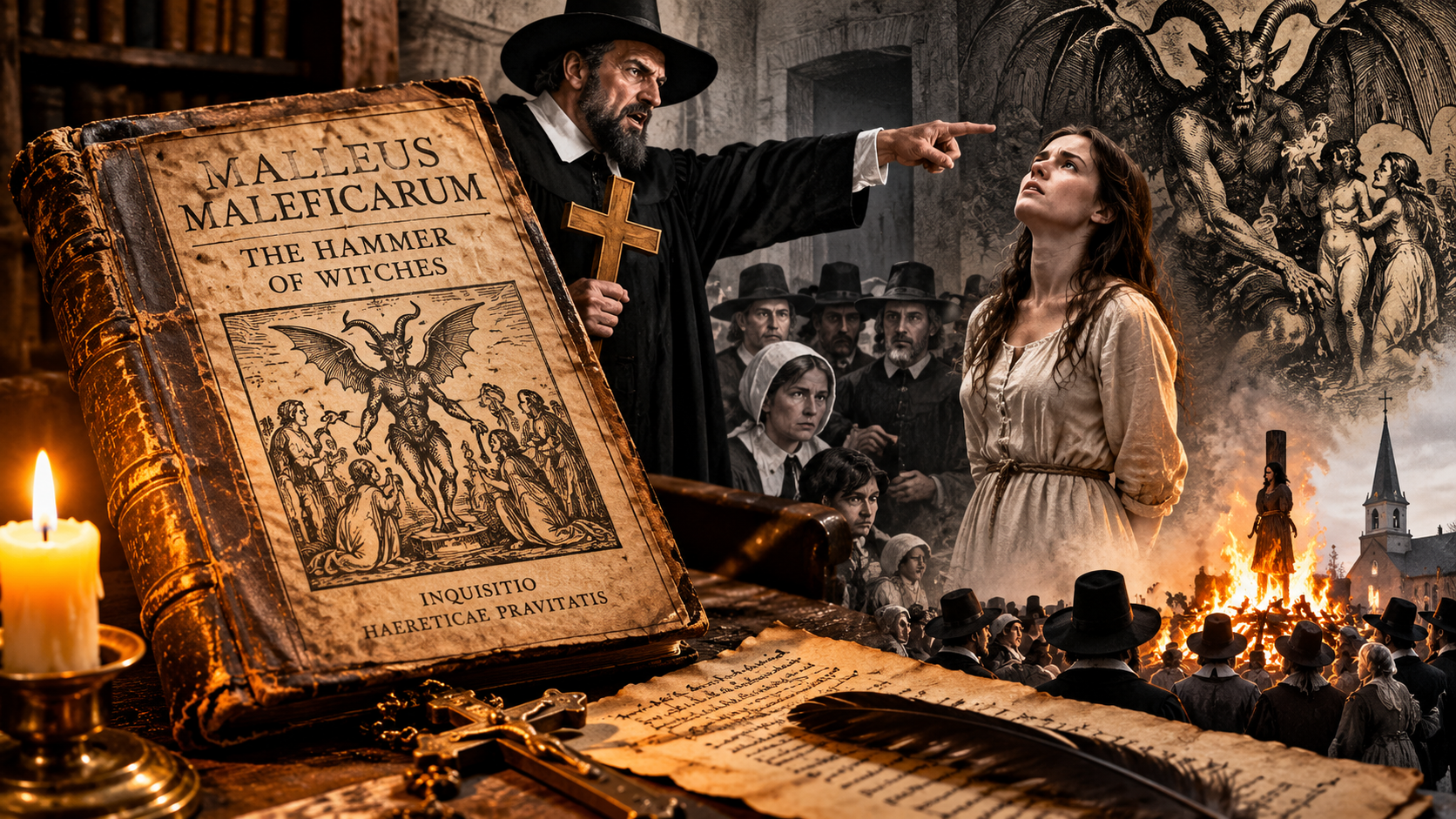
Witches weren’t always considered devil worshippers. Discover how centuries of religious teachings transformed beliefs about magic, healing, and ordinary people into accusations of serving Christianity’s greatest enemy.
By Wayne C. Robinson | The Robinson Reports
When Did Witches Become Enemies of God?
For centuries, Christians have been taught that witches are evil, that witchcraft comes from Satan, and that anyone practicing it is participating in something dangerous and ungodly.
I know because I was once among those who accepted these teachings.
I grew up hearing about Satan, demons, evil spirits, and the dangers of witchcraft. Like millions of other Christians, I believed that witches were associated with the Devil because that was what my religious upbringing taught me.
But years later, I began asking a question that changed how I understood this subject.
Who decided that witches were servants of Satan, and what evidence did they have?
The answer requires us to travel back through centuries of religious history.
What we discover is that the familiar image of witches worshipping Satan did not emerge fully formed. It developed gradually, through changing theological interpretations, religious conflicts, and the efforts of authorities who claimed to recognize supernatural evil.
Eventually, these beliefs helped justify the persecution and execution of tens of thousands of people.
But there is an important difference between proving that someone practiced a particular religion and proving that the person had entered into a supernatural agreement with the Devil.
One is a question of human conduct and belief.
The other is a claim requiring evidence that history has never credibly established.
Witchcraft Existed Long Before Christianity
The first thing we need to understand is that beliefs about magic and supernatural powers existed thousands of years before Christianity.
Ancient civilizations developed traditions involving spells, protective charms, divination, healing rituals, and communication with spiritual beings.
Ancient Egyptians, Greeks, Romans, Mesopotamians, and numerous other societies practiced or believed in forms of magic.
These traditions were not all the same.
Some practices were associated with healing or protection. Others were intended to cause harm. Many existed somewhere between religious worship, medicine, and what modern observers would classify as superstition.
The crucial point is that these beliefs existed independently of Christianity’s later teachings about Satan.
Ancient people did not need the Christian Devil to explain magic.
They had their own gods, spirits, religious traditions, and interpretations of supernatural events.
Some ancient societies also punished people accused of harmful magic. Persecution of alleged sorcery was therefore not invented by Christianity.
What developed within Christian Europe was a particularly influential interpretation connecting certain magical practices to a conspiracy involving Satan.
This distinction matters because it reveals something often overlooked.
The history of magic is much older than the Christian interpretation of witchcraft as devil worship.
How Christianity Connected Magic with Demons
As Christianity spread through the Roman Empire and Europe, Christian thinkers increasingly evaluated other religious practices through their own theological beliefs.
Practices associated with pagan religions could be classified as idolatry, superstition, or communication with demons.
Religious rituals that had once been understood within the traditions of other communities were sometimes reinterpreted as evidence of dangerous supernatural activity.
This did not happen everywhere or all at once.
Christian authorities held differing views about magic, spirits, and the reliability of claims involving supernatural powers.
Some early and medieval thinkers were skeptical of particular stories about witches.
Others became convinced that demons could influence human beings and that certain magical practices involved agreements with evil spirits.
One especially influential theologian was Augustine of Hippo, who lived from 354 to 430 CE.
Augustine’s writings contributed to the theological idea that interactions between humans and demons could involve a form of agreement or pact.
Later Christian thinkers developed these ideas further.
Gradually, certain alleged forms of magic were no longer treated simply as forbidden practices.
They could be interpreted as evidence of allegiance to Satan.
That was a significant transformation.
A person suspected of using magic was no longer necessarily viewed as someone who had violated a community’s rules.
That person could be portrayed as an enemy of Christianity itself.
And once religious authorities accepted that interpretation, the consequences could become deadly.
The Devil’s Pact: An Extraordinary Accusation
One of the most influential beliefs in the European witch hunts was the idea that witches entered into agreements with Satan.
According to this theory, witches voluntarily surrendered their loyalty to God and received supernatural powers from the Devil.
In exchange, they supposedly agreed to carry out evil acts.
These alleged powers included causing disease, destroying crops, killing livestock, harming children, and bringing misfortune upon others.
Some accused witches were said to attend secret gatherings where they worshipped Satan.
Others were accused of engaging in sexual relationships with demons.
Imagine the implications of these beliefs.
Someone’s child becomes ill.
A neighbor experiences financial hardship.
A storm destroys a farmer’s crops.
Instead of investigating the circumstances, members of the community become convinced that a witch must be responsible.
And because witches supposedly receive their powers from Satan, the accused person is automatically associated with a supernatural enemy.
But here is the question I believe should have been asked before anyone was imprisoned or executed.
Where was the evidence that Satan had entered into an agreement with this individual?
Not a confession produced through torture.
Not a neighbor’s suspicion.
Not a religious authority’s interpretation of scripture.
Actual evidence.
How could anyone demonstrate that an invisible supernatural being had given another human being the power to cause a storm or inflict an illness?
The authorities often acted as though these extraordinary allegations were established facts.
Yet the claims themselves were never credibly demonstrated.
The Book That Helped Spread Fear of Witches
In the late fifteenth century, a publication appeared that would become notorious in the history of European witch persecution.
Its title was Malleus Maleficarum, commonly translated as The Hammer of Witches.
Published in 1486–1487 and associated principally with the Dominican inquisitor Heinrich Kramer, the book promoted an aggressive approach to investigating and prosecuting alleged witches.
It presented witchcraft as a serious religious threat and reinforced the supposed connection between witches and demons.
The book also expressed strongly misogynistic attitudes, portraying women as particularly susceptible to involvement in witchcraft.
Its authorship, claims, and authority were controversial, and it was never universally accepted as official Christian doctrine.
Nevertheless, the work circulated widely and influenced subsequent discussions of witchcraft and prosecution.
Think about what this represented.
Religious writers were producing elaborate explanations of how witches supposedly operated, how they interacted with demons, and how authorities should investigate them.
But these explanations rested upon assumptions about supernatural activity.
They did not establish that the alleged powers existed.
The difference between an influential religious publication and independently verified evidence is enormous.
Yet books like The Hammer of Witches helped give extraordinary accusations an appearance of intellectual and theological authority.
And when those accusations entered courtrooms, real people suffered the consequences.
How Ordinary People Became Suspected Witches
One of the greatest tragedies of the witch hunts is that many accused individuals were ordinary members of their communities.
They were not necessarily part of any organized spiritual movement.
Many were Christians themselves.
Some practiced forms of folk medicine or healing.
Others became suspects because of personal disagreements, misfortune, or suspicious circumstances.
Imagine an elderly woman living alone in a small European village.
She knows traditional remedies.
She occasionally argues with her neighbors.
One day, a family’s cow dies shortly after an argument with her.
The family believes she caused the death through witchcraft.
Soon, other neighbors begin recalling unfortunate events they associate with her.
The accusations grow.
What began as a personal suspicion becomes a claim that she possesses supernatural powers.
Under a demonological interpretation, she may now be accused of receiving those powers from Satan.
The woman in this example is hypothetical, but the combination of neighborhood conflict, misfortune, and accusations of harmful magic reflects patterns found in historical witch trials.
Not every accused witch was a healer, and not all prosecutions followed the same pattern.
Nevertheless, the historical evidence shows how ordinary people could become targets of extraordinary allegations.
People did not need to worship Satan to be accused of serving him.
They only needed someone else to believe—or claim—that they did.
Catholic and Protestant Authorities Both Participated
It would be historically inaccurate to blame witch persecution exclusively on the Catholic Church.
Catholic and Protestant societies both participated in witch hunts.
Religious authorities, secular governments, local courts, and individual accusers all played roles.
Some regions experienced intense persecution. Others experienced relatively few prosecutions.
Attitudes toward witchcraft also changed over time, and some Christian theologians, clergy, and legal authorities criticized the trials.
Nevertheless, the idea that Satan could operate through human agents was influential across significant parts of early modern Christian Europe.
In some Protestant communities, the Devil was understood as a constant threat to believers and society.
Catholic demonological traditions also contributed to the broader intellectual environment in which alleged witchcraft was investigated.
The result was not one centrally directed campaign by all Christians.
It was a complex history in which theological beliefs interacted with political power, local conflicts, law, social pressures, and fear.
But the central problem remained.
Individuals were accused of cooperating with an alleged supernatural enemy.
And those accusations could lead to imprisonment, torture, and execution.
When Torture Produced Stories About Satan
One of the most disturbing aspects of the witch hunts was the use of torture to obtain confessions.
In some European jurisdictions, investigators believed that accused witches would not voluntarily reveal their relationships with Satan.
They therefore employed coercive interrogation.
People were pressured to confess to impossible or extraordinary activities.
Under torture, some confessed to attending secret gatherings, communicating with demons, or participating in rituals involving the Devil.
These confessions sometimes implicated other individuals, leading to further arrests and accusations.
This created a dangerous cycle.
The authorities believed witches existed.
They tortured suspected witches until some confessed.
They then treated those confessions as confirmation that their original beliefs were correct.
But torture does not provide a reliable method for establishing the truth.
A person suffering unbearable pain may say whatever seems necessary to stop the suffering.
A confession under these conditions does not demonstrate the existence of supernatural powers.
It demonstrates the vulnerability of human beings subjected to coercion.
And yet these supposed confessions contributed to prosecutions that destroyed lives.
The Great Contradiction: Fighting Evil by Committing Violence
This brings us to what I consider one of the most troubling contradictions in the history of witch persecution.
Religious and governmental authorities claimed they were protecting communities from evil.
They warned that witches might harm innocent people through supernatural powers.
They portrayed themselves as defenders of morality and religious order.
But what did some of these authorities actually do?
They imprisoned people based on questionable accusations.
They permitted torture.
They accepted unreliable confessions.
And they executed individuals accused of crimes involving supernatural powers that had never been credibly established.
Consider the contrast.
The supposed witch was accused of causing suffering through invisible forces.
The authorities inflicted suffering through physical actions that can be documented.
The supposed witch was accused of making an agreement with Satan.
The authorities used their own legal and religious institutions to authorize punishment.
The supposed witch was described as evil because of alleged supernatural wrongdoing.
Yet the documented violence frequently came from the people claiming to fight evil.
If we judge human conduct by evidence of actual harm, rather than by unproven supernatural accusations, who should be held accountable?
That question deserves far more attention than it usually receives.
Were All Historical Witches Practitioners of Witchcraft?
There is another misconception worth correcting.
Many people imagine the historical witch hunts as persecutions of an established religion resembling modern Wicca.
But historians generally distinguish between people accused of witchcraft in early modern Europe and members of modern religious movements identifying as witches.
Wicca developed as a modern religious movement in the twentieth century.
Its beliefs and practices should not automatically be projected backward onto those prosecuted centuries earlier.
Many historical defendants did not identify themselves as witches.
Some denied practicing magic altogether.
Others may have engaged in folk customs or religious practices considered suspicious by their neighbors.
The category of witch was frequently imposed upon people by their accusers.
This makes the historical injustice even more disturbing.
People could be executed not for what they believed or practiced, but for what others imagined they were doing.
Why I Began Questioning These Teachings
As a former Christian, I understand how powerful religious teachings can become.
For years, I accepted what I had been told about witches and Satan.
I did not investigate the historical development of these beliefs.
I simply assumed they were true.
That began to change during my experiences conducting tours in Salem, Massachusetts.
While working in Salem, I became interested in the people accused during the witch trials and the beliefs that led to their persecution.
I also met the sister of Laurie Cabot, a well-known figure in modern American witchcraft.
That encounter encouraged me to learn more about modern witches and to reconsider the assumptions I had carried from my Christian upbringing.
I encountered spiritual perspectives emphasizing nature, healing, and personal responsibility.
Those encounters did not prove or disprove supernatural beliefs.
But they motivated me to research the historical accusations for myself.
The more I studied, the more questions I had.
Why had I accepted claims about Satan and witchcraft without examining their origins?
Why were people accused of impossible acts treated as dangerous criminals?
Why did authorities who claimed to represent righteousness inflict such extraordinary suffering?
And why did generations of people continue accepting these accusations without demanding credible evidence?
Those questions became central to my investigation.
Eventually, they led me to write Who Was Really Evil? Witches, Satan, Christianity, and the Evidence of Who Actually Caused Harm.
Christianity Did Not Invent Magic, but It Helped Redefine the Witch
The historical record reveals a fascinating development.
Beliefs in magic existed long before Christianity.
Christian thinkers gradually developed interpretations linking certain magical practices to demons and Satan.
By the late medieval and early modern periods, influential demonologists described witches as participants in a secret conspiracy against Christianity.
Religious and secular authorities then prosecuted thousands of people accused of participating in that conspiracy.
But the existence of these accusations is not proof that the alleged supernatural conspiracy actually existed.
We have evidence that theologians wrote about Satanic witchcraft.
We have evidence that authorities believed in it.
We have evidence that people were tortured and executed because of it.
What we do not have is credible evidence that the people condemned possessed the supernatural powers attributed to them.
That distinction should fundamentally influence how we remember the witch hunts.
The historical tragedy was not simply that people feared witches.
It was that institutions converted those fears into accusations, legal proceedings, and deadly punishments.
The Question We Should Still Be Asking
Centuries have passed since the height of the European witch hunts.
Today, many people recognize the prosecutions as terrible miscarriages of justice.
But the underlying lesson is larger than witchcraft.
It concerns what happens when religious authority, fear, and social pressure become substitutes for evidence.
It concerns the danger of labeling people evil because they hold different beliefs or are suspected of possessing mysterious powers.
And it concerns our responsibility to distinguish what people are accused of doing from what the evidence actually establishes.
For centuries, witches were portrayed as enemies of Christianity.
But the historical record documents that many accused individuals became victims of systems claiming to protect society from Satan.
The question is not whether every Christian involved in the trials was malicious or whether every accused individual was virtuous.
The question is whether people should ever be subjected to cruelty and execution because others believe they have supernatural powers.
For me, the answer is clear.
No accusation should be allowed to replace evidence, and no claim of religious righteousness should excuse documented cruelty.
Discover the Book: Who Was Really Evil?
Witches, Satan, Christianity, and the Evidence of Who Actually Caused Harm
By Wayne C. Robinson
For centuries, witches were put on trial. This book puts their accusers on trial.
What began as a personal investigation into the Salem witch trials led me into the history of Christianity, Satan, demonology, and the persecution of people accused of witchcraft.
In Who Was Really Evil?, I explore the historical development of these beliefs and examine the evidence behind the accusations that led to imprisonment, torture, and execution.
This book challenges readers to question familiar narratives, examine historical responsibility, and consider a fundamental question:
Were the supposed witches truly evil—or were the people who persecuted them responsible for the greater harm?

Wayne C. Robinson
Author | Researcher | U.S. Navy Veteran Journalist
© 2026 Wayne C. Robinson. All rights reserved.
Historical references
For your published article, I recommend including these scholarly references at the bottom. They support the historical discussion and give readers ways to examine the evidence themselves.
- Wolfgang Behringer — Demonology, 1500–1660. Explains how Christian ideas about demons, including Augustine’s influence, shaped later demonological beliefs.
The Cambridge History of Christianity
- Mark A. Waddell — Witchcraft and Demonology. Examines witch hunts, the supposed Devil’s pact, torture, and the social climate surrounding prosecutions.
- Gerhild Scholz Williams — Demonologies: Writing about Magic and Witchcraft. Documents the influence of demonological literature, including Malleus Maleficarum.
- The Cambridge History of Magic and Witchcraft in the West. Examines magic before Christianity and the changing Christian interpretation of magical practices.