
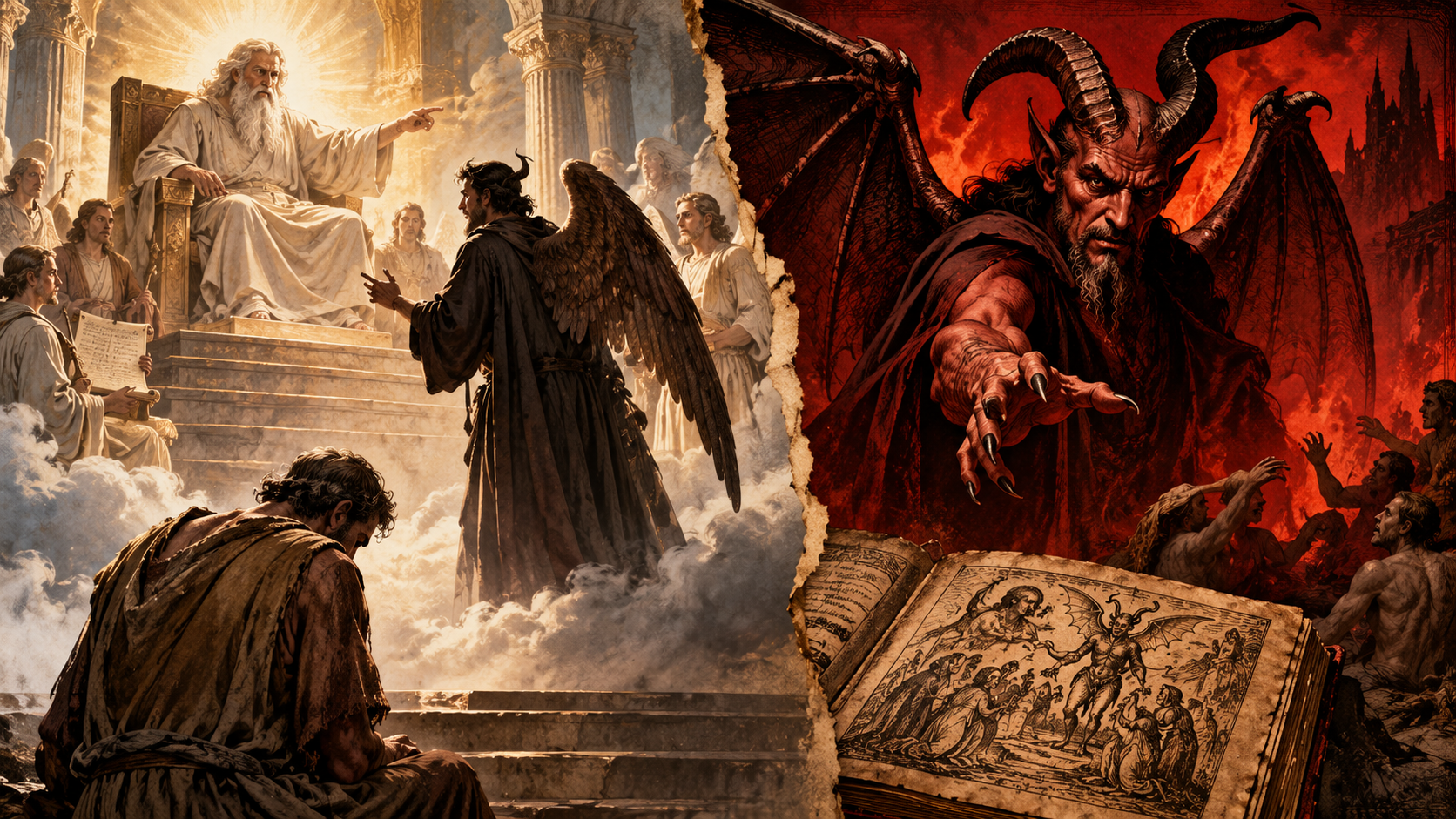
Millions of Christians believe Satan is God’s greatest supernatural enemy. But the earliest biblical writings portray a very different figure. Discover how the Devil evolved from an adversary and accuser into Christianity’s powerful embodiment of evil.
By Wayne C. Robinson | The Robinson Reports
Was Satan Always the Devil Christians Believe in Today?
For centuries, Christians have been taught that Satan is the ultimate enemy of God, a powerful supernatural being responsible for tempting humanity, spreading evil, and leading people away from salvation. In popular Christian teaching, Satan is often portrayed as a fallen angel who rebelled against God, was expelled from heaven, and now commands an army of demons dedicated to corrupting the world. His influence supposedly explains everything from personal temptation to spiritual possession, witchcraft, and the eternal punishment of sinners.
As a former Christian, I am familiar with these teachings. I heard about Satan in churches, religious discussions, and interpretations of biblical scripture. Like many believers, I accepted the basic story without seriously questioning where it originated or whether the earliest biblical writers understood Satan in the same way that modern Christians do. I assumed that the Devil described by contemporary preachers had always existed as a clearly defined figure throughout the Bible.
My perspective began to change when I started investigating the historical development of religious beliefs. I discovered that the concept of Satan did not emerge in a single moment and that the earliest biblical references differ significantly from the figure presented in later Christian theology. The Hebrew scriptures, Jewish religious literature, the New Testament, and centuries of Christian interpretation reveal a gradual development in which the role and characteristics of Satan changed considerably.
This historical development raises a fascinating question. If Satan has always existed as Christianity’s great supernatural enemy, why do the earliest biblical writings portray him so differently? Understanding that question requires examining the meaning of the name Satan, the religious environment of ancient Israel, and the ways that Jewish and Christian thinkers developed their ideas about evil.
The Original Meaning of Satan: An Adversary, Not Necessarily the Devil
The English name Satan comes from the Hebrew word satan, which means an adversary, opponent, or accuser. In several passages of the Hebrew Bible, the term refers to ordinary opposition rather than a specific supernatural being. An adversary might be a human enemy, someone obstructing another person’s activities, or even an angel carrying out an assignment from God. The word did not always function as the personal name of an independent supernatural ruler of evil.
An interesting example appears in Numbers 22, where an angel of the Lord stands in the path of Balaam to oppose him. The Hebrew text uses the word satan to describe the angel’s role as an adversary. This is particularly revealing because the angel is acting on God’s instructions rather than rebelling against him. The word describes opposition, but it does not automatically imply wickedness, demonic power, or hostility toward God.
A similar use appears in 1 Kings 11, where human political opponents are described with the same Hebrew term. Hadad the Edomite and Rezon are presented as adversaries of Solomon. These passages demonstrate that the word could describe opposition in an ordinary political or personal sense. It would be historically misleading to assume that every appearance of the word refers to the Devil of later Christian belief.
This distinction matters because modern readers often approach ancient scripture with definitions inherited from centuries of Christian teaching. When they encounter the word Satan, they may automatically imagine a fallen angel who rules over demons and opposes God. Yet the original language and context frequently indicate a much broader meaning. To understand how Satan became the Devil, we must first recognize that the earliest use of the term did not always refer to the supernatural figure Christians recognize today.
Satan in the Book of Job: A Member of God’s Heavenly Court
One of the most important passages for understanding the early development of Satan appears in the Book of Job. In its opening chapters, a figure called ha-satan, commonly translated as “the adversary” or “the accuser,” appears among the heavenly beings presenting themselves before God. Rather than functioning as an independent ruler commanding a rival kingdom, this figure participates in a scene resembling a divine council or heavenly court.
During the exchange, God draws attention to Job’s righteousness and faithfulness. The accuser questions whether Job’s devotion is genuine, suggesting that Job remains faithful only because God has protected him and blessed him with prosperity. According to the accuser, removing these advantages would reveal that Job’s loyalty is conditional. God then permits Job to be tested, placing limits on what the accuser may do.
The resulting suffering is extraordinary. Job loses his possessions, his children die, and he eventually experiences severe physical affliction. Yet the narrative makes clear that the accuser operates within boundaries established by God. He does not appear as a completely autonomous supernatural opponent capable of acting independently of divine permission. His role is closer to that of a challenger or prosecutor who questions human righteousness.
For readers accustomed to the Christian image of Satan as God’s sworn enemy, this presentation may be surprising. In Job, the accuser enters God’s presence, speaks with him, and receives permission to test a human being. The text does not present the elaborate history of a fallen angel’s rebellion or describe Satan as the ruler of hell. These ideas would receive fuller development through later religious traditions and interpretations.
The Book of Job raises another uncomfortable question about responsibility for suffering. If the accuser acts only with divine permission, how should readers interpret the moral relationship between God, the accuser, and Job’s suffering? Religious traditions offer different answers, but the question demonstrates that the ancient narrative is more complex than the familiar story of an evil Devil independently attacking innocent humanity.
The Accuser in Zechariah: Another Heavenly Courtroom
Another important reference appears in Zechariah 3, where Joshua the high priest stands before an angel of the Lord while Satan stands nearby to accuse him. The setting once again resembles a judicial proceeding in which an accuser challenges the standing of another individual. God rebukes the accuser, but the passage does not provide a detailed biography of Satan as a fallen angel or establish the complete supernatural hierarchy found in later Christian traditions.
Like the account in Job, this passage reflects an understanding of Satan closely connected with accusation and opposition. The figure’s role is significant, but his identity and function remain different from the fully developed Devil of later theology. Scholars studying the Hebrew Bible frequently distinguish these divine-council passages from later Jewish and Christian descriptions of Satan as a cosmic enemy.
The importance of these passages lies not in proving that ancient Israelites rejected every belief in malevolent spiritual beings. Ancient Israelite religion included a variety of ideas about divine beings, spirits, harmful supernatural forces, and divine punishment. Rather, the passages demonstrate that the concept of Satan had not yet assumed all the features that would eventually characterize mainstream Christian demonology.
The difference becomes clearer when we compare the Hebrew Bible with religious writings produced in later centuries. Over time, Jewish literature increasingly described powerful supernatural beings associated with corruption, temptation, and opposition to God’s purposes. These developments helped create the religious environment in which the New Testament understanding of Satan would emerge.
Who Caused David to Take a Census: God or Satan?
One of the most revealing comparisons in the Bible involves the story of King David’s census. In 2 Samuel 24:1, the narrative attributes the incitement of David to conduct the census to the Lord’s anger against Israel. However, 1 Chronicles 21:1 presents Satan as the figure who incited David to take the census. The two passages describe the same general event but assign the immediate instigation differently.
This difference has attracted considerable attention from biblical scholars because Chronicles was composed later than Samuel. The comparison suggests a developing tendency within biblical literature to distinguish divine goodness from certain actions that produce suffering or punishment. Instead of attributing the troubling impulse directly to God, the later account introduces Satan as the agent responsible for inciting David.
Religious interpreters have offered various ways to reconcile these passages, including the argument that God permitted Satan to act while retaining ultimate authority. Such interpretations are important within theological traditions, but they should be distinguished from historical analysis of the texts themselves. From a historical perspective, the passages provide valuable evidence that the role attributed to Satan changed across different stages of biblical writing.
This comparison should encourage readers to examine scripture carefully rather than assume that every biblical author possessed an identical understanding of the supernatural world. The Bible is a collection of writings produced in different historical circumstances, and those writings reflect developments in religious language, interpretation, and belief. Recognizing these developments does not automatically resolve questions about God’s existence or Satan’s reality, but it does challenge the assumption that the familiar Christian portrait of the Devil was presented consistently from the beginning.
Did Other Religions Influence the Development of Satan?
Ancient Judaism did not develop in isolation. Jewish communities interacted with neighboring cultures, including Mesopotamian, Persian, Greek, and other societies whose religious traditions contained different explanations of good, evil, and supernatural conflict. These encounters occurred over long periods and created opportunities for religious ideas to influence one another.
One tradition frequently discussed in this context is Zoroastrianism, an ancient Iranian religion associated with the teachings of Zarathustra, also known as Zoroaster. Zoroastrian religious thought developed ideas involving a cosmic struggle between truth and falsehood, good and destructive spiritual forces. Angra Mainyu, also called Ahriman in later traditions, became associated with destructive opposition to the good divine order.
Some scholars have proposed that interaction with Persian religious ideas contributed to developments in Jewish beliefs about angels, evil spirits, resurrection, judgment, and cosmic conflict. The extent of that influence remains debated, and the surviving evidence does not justify treating Christianity’s Satan as a simple copy of a Persian figure. Jewish religious traditions also possessed their own internal resources for explaining evil and developing ideas about supernatural beings.
Nevertheless, the comparison demonstrates that concepts resembling a cosmic struggle between good and evil existed outside Christianity. Ancient religious traditions influenced one another in complex ways, and ideas that later became central to Christian theology had historical precedents and parallels. The emergence of Satan as a powerful supernatural opponent must therefore be examined within the broader religious environment of the ancient Near East.
For someone who was taught that the Christian Devil represented a fixed and unchanging supernatural reality, discovering these historical connections can be unsettling. Yet investigating the origins of a belief is not an attack on anyone’s freedom to hold it. It is simply an effort to understand how religious concepts developed and why people in different historical periods described the supernatural world in different ways.
From Heavenly Accuser to Cosmic Enemy
During the centuries before Christianity emerged, Jewish religious literature developed increasingly elaborate descriptions of angels, rebellious heavenly beings, evil spirits, and supernatural opposition. This period, commonly called the Second Temple era, included the production of writings that expanded upon themes found in earlier biblical traditions. Texts associated with Enoch, Jubilees, and communities represented by the Dead Sea Scrolls provide examples of the diversity of Jewish thought about supernatural evil.
The Book of 1 Enoch is especially important because portions of it describe heavenly beings who descend to earth, engage in forbidden relationships, and contribute to human corruption. The identities and roles of the supernatural figures differ across the book’s various sections, and these traditions should not be treated as identical to later Christian teachings about Satan. Nevertheless, they demonstrate that ideas involving rebellious angels and supernatural wickedness were circulating before the composition of the New Testament.
Other writings developed figures such as Mastema and Belial, who could represent hostility, temptation, or opposition to God’s people. These figures were not always interchangeable, and different Jewish communities understood supernatural evil in different ways. The development was therefore neither uniform nor straightforward. What emerged was a broader religious environment in which stories of cosmic conflict and hostile spiritual powers became increasingly prominent.
By the first century CE, some Jewish groups understood evil in terms of powerful supernatural opposition, creating a context in which early Christianity could portray Satan as more than a heavenly accuser. The transformation did not begin with Christianity alone, but Christian writers and theologians would give these developing traditions new significance within their understanding of Jesus, salvation, and the final defeat of evil.
How the New Testament Transformed Satan’s Role
In the New Testament, Satan appears much more clearly as a supernatural opponent associated with temptation, deception, and resistance to God’s purposes. The Gospels describe Jesus being tempted by the Devil in the wilderness, while other passages connect Satan with demonic activity and spiritual conflict. These accounts reflect a religious environment in which the concept of a powerful adversarial spirit had become considerably more developed than the role of the accuser in Job.
In Matthew 4 and Luke 4, Satan tempts Jesus by offering alternatives to obedience to God. The Devil is presented as a being who seeks to divert Jesus from his mission, using appeals involving hunger, power, and worldly authority. These episodes reinforce an understanding of Satan as a supernatural tempter rather than simply an accuser within a heavenly court. The narrative also contributes to the Christian theme of Jesus confronting and overcoming the forces of evil.
Other New Testament writings describe Satan as deceptive, dangerous, and influential in the world. Paul refers to Satan in passages concerning temptation and spiritual opposition, while the Gospel of John contains language associating the Devil with falsehood and hostility to truth. These descriptions helped establish the foundation for later Christian teachings about Satan’s role in human sin and spiritual conflict.
The Book of Revelation adds another influential element by presenting dramatic visions of conflict between heavenly forces and a great dragon identified with the Devil and Satan. Revelation 12 describes war in heaven involving Michael and his angels, followed by the dragon’s defeat and expulsion. This imagery became central to later interpretations portraying Satan as a rebellious heavenly being destined for final destruction.
The historical development is significant. The New Testament Satan is considerably closer to the figure recognized in modern Christianity than the accuser appearing in Job. Yet later Christian theology would continue expanding the narrative, combining passages from different biblical books to construct a more complete story of Satan’s origin, rebellion, character, and ultimate fate.
Was Lucifer Originally Another Name for Satan?
One of the most familiar ideas in popular Christianity is that Satan was originally a beautiful angel named Lucifer who became proud, rebelled against God, and was cast out of heaven. This story is often presented as though the Bible provides a single, detailed account of the Devil’s origin. In reality, the familiar narrative depends on interpretations that combine several passages written in different historical contexts.
The name Lucifer became associated with Isaiah 14:12 through the Latin biblical tradition. The Hebrew passage contains an expression commonly translated as “shining one, son of dawn,” and appears within a poetic denunciation of the king of Babylon. In its immediate literary setting, the passage mocks the downfall of a powerful earthly ruler whose arrogance has led to humiliation.
Later Christian interpreters associated the language of a heavenly fall with Satan’s supposed rebellion against God. A similar interpretive development occurred with Ezekiel 28, a passage addressing the ruler of Tyre through elaborate imagery of pride and downfall. Although these texts originally concern historical rulers, their language contributed to later Christian traditions about the Devil’s former glory and expulsion from heaven.
This does not mean that Christian theologians invented every element of the fallen-angel tradition without precedent. Jewish literature already contained narratives involving rebellious heavenly beings, and the New Testament included imagery of Satan’s defeat and expulsion. The important point is that the familiar biography of Lucifer as the original name of Satan developed through the combination and interpretation of different texts rather than appearing as a single straightforward account in the Hebrew Bible.
For readers interested in the historical origins of religious teachings, these distinctions are essential. They reveal how scriptural interpretation can transform a poetic passage about a human king into an influential explanation of supernatural history. Once such interpretations become established through centuries of preaching, art, and religious education, many believers may assume they were always the original meaning of the text.
How Satan Became Connected to Witches
The historical development of Satan had consequences extending far beyond biblical interpretation. As Christian theology developed more elaborate ideas about the Devil and demonic influence, certain religious authorities increasingly interpreted magic and suspected witchcraft through the framework of supernatural opposition to God. Practices once understood as folk customs, harmful magic, divination, or forbidden religious activities could be reclassified as evidence of communication or cooperation with demons.
By the late medieval and early modern periods, influential demonologists were describing alleged witches as participants in a conspiracy against Christianity. According to these theories, witches obtained supernatural powers through agreements with Satan and used those powers to harm individuals, communities, and the Christian social order. Some writers claimed that witches attended secret gatherings, worshipped the Devil, and participated in elaborate rituals. These accusations contributed to a terrifying image of witchcraft as organized supernatural rebellion.
The consequences were devastating. Thousands of people were prosecuted across Europe during the early modern witch hunts, and historical estimates generally place the number executed between approximately 40,000 and 60,000. Catholic and Protestant societies both participated in these persecutions, although the scale and legal procedures varied considerably among different regions. Secular courts, political authorities, and local communities also played major roles in determining who was accused and punished.
The connection between Satan and witchcraft illustrates the danger of treating theological speculation as established criminal evidence. Authorities believed that invisible supernatural forces were responsible for real-world misfortunes, and they pursued individuals supposedly associated with those forces. Yet the allegations of demonic pacts, supernatural attacks, and secret conspiracies were never credibly demonstrated. The arrests, torture, and executions inflicted upon accused people, however, are documented historical events.
This is why the development of Satan became an important part of my research. Understanding how a supernatural figure evolved within religious traditions helps explain how later communities came to fear people accused of serving that figure. The transformation of Satan from an adversary in ancient texts into a cosmic enemy was not merely a theological development. It became part of the intellectual background that allowed accusations of witchcraft to carry deadly consequences.
What Does the Historical Evidence Actually Prove?
When investigating Satan, it is important to distinguish between several different questions. One concerns the historical origins of the word and the development of beliefs associated with it. Another concerns what ancient authors intended when they described supernatural beings. A third, much larger question concerns whether a supernatural entity corresponding to those descriptions actually exists.
Historical scholarship can address the first two questions through language, archaeology, textual comparison, and the study of religious traditions. Researchers can examine how the word satan was used, how its meaning changed, and how different communities interpreted biblical passages. They can also identify similarities and differences among religious traditions and investigate the circumstances in which particular beliefs emerged.
The third question is more difficult because it concerns claims about supernatural reality. Historical texts demonstrate that people believed in Satan, described encounters with supernatural beings, and developed elaborate explanations of evil. Those texts do not independently establish that the supernatural being described actually existed. A written account of a religious belief is evidence that the belief was expressed, not automatically evidence that its supernatural claims are true.
This distinction does not prevent believers from accepting Satan’s existence as a matter of faith. Religious communities may understand scripture as divine revelation and interpret its accounts accordingly. But faith-based conclusions and historically verifiable conclusions are not identical. Someone attempting to determine what can be demonstrated through evidence must recognize the difference.
After examining the historical development of Satan, I came to question explanations I had previously accepted without investigation. The changing portrayals across different religious texts made me more interested in the human processes through which beliefs are formed, transmitted, and transformed. I began asking not simply whether a particular teaching appeared in the Bible, but when that teaching developed, how it was interpreted, and what evidence supported its claims.
Why This History Changed My Understanding of Christianity
My interest in Satan’s historical origins is part of a broader investigation into Christianity and the religious beliefs that influenced my early life. As a former Christian, I spent years accepting teachings about the Devil, demons, witchcraft, and supernatural evil. These beliefs were presented as essential features of the spiritual world, and I rarely considered whether their familiar modern forms differed from the ideas found in ancient religious texts.
That began to change as I researched the history of witchcraft accusations and the persecutions carried out against people accused of serving Satan. My experiences conducting tours in Salem, Massachusetts, encouraged me to investigate the historical treatment of witches and the religious assumptions used to justify their prosecution. During that period, I also met the sister of Laurie Cabot, a prominent figure associated with modern witchcraft. That encounter motivated me to question the negative image of witches I had inherited from Christian teaching.
As my investigation expanded, I realized that understanding the history of witchcraft required examining the history of Satan himself. If people were imprisoned and executed because authorities believed they had made agreements with the Devil, then the origins of those beliefs were directly relevant to evaluating the accusations. I wanted to understand how religious ideas developed into doctrines and how those doctrines influenced the treatment of real human beings.
The research eventually led me to a broader question about the relationship between belief, evidence, and responsibility. Even if religious authorities sincerely believed Satan was operating through accused witches, that belief did not establish that the accused had committed supernatural crimes. The surviving historical records reveal the development of demonological theories and the persecution that followed, but they do not provide credible evidence that the condemned possessed the magical powers attributed to them.
These discoveries became central to my book, Who Was Really Evil? Witches, Satan, Christianity, and the Evidence of Who Actually Caused Harm. My purpose is not to demand that every reader adopt my conclusions about religion. It is to encourage readers to examine the historical record, question inherited assumptions, and distinguish extraordinary accusations from documented conduct.
Did Satan Exist Before Christianity?
The answer depends on what we mean by the question. If we are asking whether the word satan and beliefs about supernatural adversaries existed before Christianity, the answer is clearly yes. The Hebrew Bible contains references to adversaries and an accusing heavenly figure, while Jewish writings produced before Christianity developed additional concepts involving hostile spirits, cosmic conflict, and supernatural evil.
If, however, we are asking whether the fully developed Devil of later Christian theology existed as a clearly defined concept throughout ancient Israelite religion, the historical evidence suggests otherwise. The figure evolved through centuries of religious interpretation and literary development. Different texts portray Satan in different ways, and many features commonly associated with the Devil emerged or acquired greater importance in later traditions.
The distinction between those answers is essential. Demonstrating that a religious concept existed before Christianity is not the same as proving the existence of the supernatural being described by that concept. Historical research can trace the development of an idea, but it cannot transform an ancient supernatural claim into independently verified fact simply because the claim appears in scripture.
For me, the history of Satan provides a powerful reminder of why inherited beliefs deserve examination. Religious ideas can become so familiar that people assume they have always existed in their present form. Yet the historical record often reveals centuries of interpretation, disagreement, and change. Understanding that development does not require hostility toward religious believers; it requires curiosity about where our ideas originated and a willingness to follow the evidence.
The story of Satan also offers an important lesson about the consequences of supernatural accusations. Once communities came to believe that certain individuals possessed powers granted by the Devil, accusations involving invisible forces could become the basis for imprisonment, torture, and execution. The historical reality of those punishments should make us especially careful about accepting extraordinary claims without reliable proof.
For centuries, people accused of serving Satan were condemned for supernatural crimes that could not be credibly established. The suffering inflicted upon those individuals, however, is documented history. Perhaps the question we should be asking is not simply whether Satan exists, but how belief in Satan influenced the actions of human beings who claimed to be fighting evil.
Discover the Book: Who Was Really Evil?
Witches, Satan, Christianity, and the Evidence of Who Actually Caused Harm
By Wayne C. Robinson
For centuries, witches were put on trial. This book puts their accusers on trial.
What began as my personal investigation into the Salem witch trials eventually led me into the history of Satan, Christian demonology, and the persecution of people accused of witchcraft. As a former Christian, I wanted to understand whether the beliefs I had accepted about witches and supernatural evil were supported by historical evidence.
In Who Was Really Evil?, I examine the development of these religious ideas and the documented consequences of the accusations they inspired. The book challenges readers to distinguish between beliefs about supernatural wrongdoing and the real suffering inflicted upon people in the name of fighting evil.
This is not simply a book about the Devil or the history of witchcraft. It is an investigation into religious authority, human responsibility, and the importance of demanding evidence before condemning another person.
Read the history. Examine the evidence. Decide for yourself.

Historical references
These are useful references to include at the bottom of the published article:
- My Jewish Learning — Satan the Adversary — Explains how Satan appears in the Hebrew Bible, particularly in Job and Zechariah.
My Jewish Learning
- Journal of Theological Studies — New Testament Satanology — Academic analysis of Satan and other supernatural opponents in Second Temple Jewish literature.
Oxford Academic
- Encyclopaedia Iranica — Zoroastrianism and Religious Influence — Discusses Zoroastrian beliefs and their possible influence on neighboring religions.
Encyclopaedia Iranica
Wayne C. Robinson
Author | Researcher | U.S. Navy Veteran Journalist
© 2026 Wayne C. Robinson. All rights reserved.