
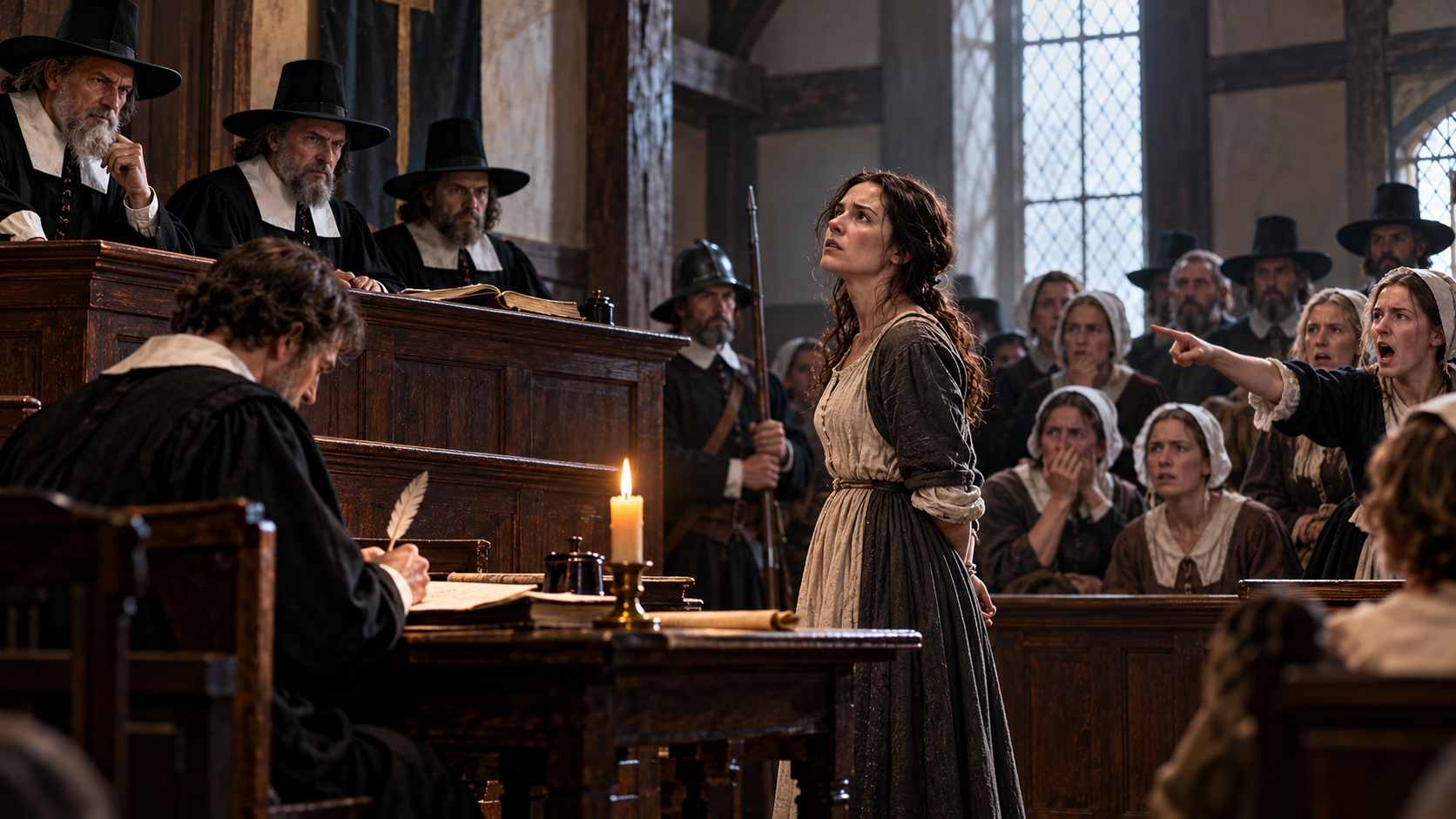
In 1692, innocent people were imprisoned and executed because their neighbors believed they possessed supernatural powers. How did religious fear become accepted as evidence, and who was responsible for the real evil?
By Wayne C. Robinson | The Robinson Reports
When Fear Became a Death Sentence
Imagine living in a community where someone could accuse you of a crime you never committed, involving supernatural powers you did not possess, and where your denial might be interpreted as further evidence of guilt. Your accuser would not necessarily need physical evidence, reliable witnesses, or proof that any crime had actually occurred. An allegation that your invisible spirit had attacked someone could be enough to bring you before the authorities, where your freedom and perhaps your life would depend on the judgment of people who genuinely believed that Satan was operating within their community.
This was the terrifying reality faced by many residents of Salem, Massachusetts, in 1692. During a period of intense religious anxiety and social instability, allegations of witchcraft spread throughout the community, eventually implicating approximately 200 people. Nineteen individuals were hanged, one man was pressed to death beneath heavy stones, and at least five others died in prison. Families were devastated, reputations destroyed, and innocent people condemned through proceedings that historians now recognize as one of the most notorious miscarriages of justice in American history.
What makes these events particularly disturbing is the extraordinary nature of the crimes alleged. The defendants were accused of using supernatural powers to inflict suffering, appearing as invisible spirits, and participating in activities associated with Satan. Yet the surviving records do not provide credible evidence that any of the accused actually possessed such powers. What the records do establish is that human beings imprisoned, prosecuted, and executed other human beings because they believed these supernatural accusations were true.
This distinction raises a question that has fascinated me since my experiences conducting tours in Salem many years ago. If the supposed supernatural crimes of the accused were never demonstrated, while the suffering inflicted by their persecutors is historically documented, who was responsible for the actual harm? That question eventually became central to my book, Who Was Really Evil? Witches, Satan, Christianity, and the Evidence of Who Actually Caused Harm.
Salem in 1692: A Community Shaped by Religious Fear
To understand how the Salem witch trials occurred, we must examine the society in which they developed. Seventeenth-century Massachusetts was heavily influenced by Puritan Christianity, a religious tradition that shaped colonial laws, community expectations, education, and everyday life. Many Puritans believed that Satan was an active supernatural force attempting to undermine Christian society, and they interpreted certain unexplained events through this religious framework. Illness, unusual behavior, failed harvests, and other misfortunes could be understood not simply as natural occurrences but as possible signs of spiritual conflict.
The residents of Salem also faced genuine social and political pressures. Massachusetts had experienced significant governmental instability, while warfare involving English colonists and Indigenous peoples created insecurity throughout New England. Economic disagreements, disputes over property, and tensions between residents of Salem Village and the nearby commercial community of Salem Town further contributed to an atmosphere of uncertainty. These conditions did not inevitably produce witch trials, but they helped create an environment in which frightening explanations for misfortune could gain considerable influence.
Christian Involvement
Religious belief became particularly consequential when combined with the authority of the colonial legal system. Massachusetts law recognized witchcraft as a capital offense, reflecting both English legal traditions and biblical interpretations that condemned certain supernatural practices. When authorities believed that witches were operating within their communities, accusations could therefore trigger formal criminal proceedings carrying the possibility of execution.
The tragedy was not simply that people believed in witchcraft. Belief in supernatural forces was widespread across many societies, both Christian and non-Christian. The fundamental problem arose when authorities allowed those beliefs to determine criminal responsibility without demanding reliable evidence that the alleged acts had occurred. By treating invisible spiritual activity as a matter that could be established through accusations and testimony, the legal system created circumstances in which ordinary people could be condemned for crimes they had no meaningful way to disprove.
The Accusations That Started the Witchcraft Panic
The crisis began in early 1692 when Betty Parris, the young daughter of Reverend Samuel Parris, and her cousin Abigail Williams experienced unusual symptoms and behavior that alarmed members of the household and community. Their condition was interpreted by some observers as evidence of supernatural affliction, and suspicions of witchcraft soon emerged. Rather than establishing a reliable explanation for the girls’ behavior, community members increasingly focused on the possibility that someone was deliberately tormenting them through supernatural means.
Three women became the first major targets of the accusations: Sarah Good, Sarah Osborne, and Tituba. Their circumstances differed considerably, but each was vulnerable within the community. Sarah Good lived in poverty and had a troubled reputation among some neighbors, while Sarah Osborne was associated with family and inheritance disputes. Tituba was an enslaved woman in the household of Reverend Parris, placing her in a particularly powerless social position. Although the details of their examinations and responses varied, all three became entangled in allegations that they were responsible for the girls’ suffering.
Organized Conspiracy?
Tituba’s confession became an especially important development. During questioning, she described supernatural activities and implicated other supposed witches, contributing to the perception that Salem was facing an organized conspiracy. Historians continue to debate aspects of her background and the circumstances surrounding her confession, including the extent of coercion involved. What is clear is that authorities treated her statements as support for an expanding investigation rather than questioning whether the underlying supernatural claims could be substantiated.
As accusations spread, individuals who had previously enjoyed respectable positions within the community became suspects. Neighbors accused neighbors, family relationships were strained, and personal disagreements could acquire frightening religious significance. The expanding number of accusations appeared to confirm the fears of those who already believed that Satan was organizing a conspiracy against the colony. Instead of recognizing that collective fear could generate further accusations, authorities increasingly interpreted the growing list of suspects as evidence that their supernatural assumptions were correct.
This created a dangerous cycle in which accusations encouraged investigations, investigations produced more allegations, and each new allegation reinforced the belief that witchcraft was widespread. Once the community accepted the premise that invisible supernatural forces were causing its problems, almost any unexplained misfortune could become additional evidence of their presence. The resulting panic demonstrated how quickly suspicion can become self-reinforcing when people abandon the distinction between belief and proof.
Spectral Evidence: When Invisible Spirits Became Legal Testimony
Perhaps the most troubling feature of the Salem witch trials was the use of spectral evidence, a form of testimony involving alleged appearances of a person’s spirit or apparition. Witnesses claimed that the invisible forms of accused individuals had appeared before them, attacked them, or caused physical suffering. Because the alleged events were supernatural, the accused often had no practical means of challenging the testimony through ordinary evidence. A person might be physically present in one location while someone elsewhere claimed to have been assaulted by that person’s spirit.
The central problem with spectral evidence was its lack of independent verification. If a witness claimed to see an apparition, there was no reliable method for establishing that the apparition existed, that it represented the accused person, or that the accused had caused the experience. Nevertheless, such testimony was admitted during proceedings before the special Court of Oyer and Terminer, which was established in 1692 to hear witchcraft cases. The court considered other kinds of testimony as well, but spectral allegations became an especially controversial part of the prosecutions.
Religious assumptions complicated the issue further. Some people believed that Satan could use the appearance of an innocent person to deceive observers, while others argued that such appearances indicated the accused individual’s involvement in witchcraft. This disagreement raised an important question about whether spectral testimony could establish guilt at all. If the Devil was believed capable of impersonating innocent people, how could anyone confidently conclude that an alleged apparition proved the accused had committed a supernatural crime?
Eventually, increasing doubts about spectral evidence contributed to the collapse of the prosecutions. When the Court of Oyer and Terminer was dissolved and a new court adopted a more restrictive approach toward spectral testimony, convictions became far less common. This development reveals the significance of evidentiary standards. The supernatural accusations had not suddenly disappeared, but the willingness of authorities to treat certain claims as sufficient grounds for conviction had changed.
The lesson is fundamental to any system of justice. An accusation should not become proof merely because a witness sincerely believes it, particularly when the alleged event cannot be independently verified. In Salem, the failure to maintain that distinction contributed to the deaths of people who could not meaningfully defend themselves against invisible crimes.
Bridget Bishop: The First Person Executed
Bridget Bishop became the first person executed during the Salem witch trials when she was hanged on June 10, 1692. Her prosecution involved allegations of supernatural wrongdoing, testimony about supposed apparitions, and claims concerning unusual events associated with her. Witnesses also raised suspicions based on her behavior and reputation. Although these accusations persuaded the court to convict her, they did not establish that she possessed the supernatural powers attributed to her.
Bishop’s case illustrates the fundamental difference between documenting a historical conviction and demonstrating the truth of the accusation that produced it. Court records establish that she was investigated, tried, found guilty, and executed. They also reveal the kinds of testimony that authorities considered persuasive. However, none of those records provides independently verifiable evidence that Bishop could communicate with Satan or harm others through magical powers.
This distinction matters because historical accounts sometimes repeat accusations without sufficiently emphasizing their evidentiary limitations. When we read that a person was convicted of witchcraft, we must remember that a conviction reflects a court’s judgment under the legal and cultural standards of its time. It does not establish that the supernatural events described by witnesses actually occurred. Bridget Bishop’s execution is therefore evidence of a deadly prosecution, not proof of supernatural witchcraft.
Her death also demonstrates how accusations shaped by religious beliefs could become instruments of irreversible punishment. A woman lost her life because authorities accepted allegations that modern historical investigation cannot substantiate. The injustice becomes especially clear when we recognize that the execution itself is an established fact, while the extraordinary powers attributed to the victim remain unproven.
Rebecca Nurse: When a Good Reputation Was Not Enough
Rebecca Nurse’s prosecution provides another disturbing example of the Salem witch trials. An elderly woman and a respected member of the community, Nurse was known for her religious devotion and had supporters who believed strongly in her innocence. Despite her reputation, she became the subject of witchcraft accusations and was brought before the court. Her case demonstrated that neither age, social standing, nor a history of Christian observance necessarily protected someone once suspicion took hold.
During Nurse’s trial, the jury initially returned a verdict of not guilty. After objections and further consideration, however, the jurors reconsidered their decision and found her guilty. She was executed on July 19, 1692, along with several other accused individuals. Her conviction remains one of the most striking examples of how fear and questionable testimony could overcome evidence of a person’s longstanding character.
The circumstances surrounding Nurse’s trial reveal how difficult it had become for accused individuals to defend themselves. Even when respected neighbors testified in support of a defendant, supernatural allegations could outweigh more reliable observations of ordinary conduct. The court’s willingness to reconsider an acquittal in the face of pressure further illustrates the extraordinary atmosphere surrounding the proceedings.
Rebecca Nurse was a Christian woman accused of cooperating with Satan. The people who condemned her believed they were protecting a Christian community from supernatural evil, yet their actions resulted in the execution of a person whose alleged supernatural crimes were never credibly established. Her story challenges the assumption that religious certainty necessarily produces justice. It demonstrates instead how deeply held beliefs can become dangerous when they are allowed to override reliable evidence and procedural fairness.
Giles Corey: A Man Crushed to Death Without a Conviction
Among the most horrifying episodes of the Salem witch trials was the death of Giles Corey, an elderly farmer accused of witchcraft. Unlike many other defendants, Corey refused to enter a plea before the court. Under the legal procedures being applied, authorities attempted to compel him to plead by subjecting him to peine forte et dure, a punishment involving the placement of increasingly heavy stones upon his body. On September 19, 1692, Corey died as a result of this treatment.
Corey’s death was especially significant because he was never convicted of witchcraft. The punishment was imposed because he refused to submit a plea, not because a court had established that he had committed the alleged supernatural offense. Whatever the authorities believed about witchcraft, their responsibility for the physical punishment inflicted upon him is a matter of historical record. The stones were real, the suffering was real, and the death was real.
This case illustrates the difference between supernatural allegations and documented human conduct more clearly than almost any other event associated with Salem. Corey was accused of participating in an invisible form of evil, yet he died because identifiable human authorities subjected him to an extraordinary form of physical violence. No supernatural force was required to explain his death. The punishment was carried out through human decisions within an established legal process.
When we examine responsibility for the tragedy, the relevant historical evidence concerns the authorities who permitted the punishment and the legal system that made it possible. Whether individual participants sincerely believed they were protecting society does not eliminate the moral questions raised by their actions. Corey’s death is a reminder that injustice can become especially dangerous when institutions treat their own authority as sufficient justification for cruelty.
Were Witches Burned at the Stake in Salem?
One of the most persistent misconceptions surrounding the Salem witch trials is that the accused were burned alive. Popular films, illustrations, and fictional accounts frequently associate witch persecutions with public burnings, leading many people to assume that this was the method of execution used in colonial Massachusetts. In reality, no one was executed by burning during the Salem witch trials. Nineteen people were hanged, Giles Corey was pressed to death, and several others died while imprisoned.
Burning was used in some European witch persecutions, although methods of execution varied by jurisdiction and period. In certain regions, convicted individuals were strangled before their bodies were burned, while in others burning alive was imposed. The circumstances differed considerably across Europe, and it would be inaccurate to treat all witch persecutions as though they followed the same legal procedures. Salem’s history must therefore be distinguished from the broader European experience.
Correcting this misconception does not diminish the cruelty of the Salem proceedings. On the contrary, accuracy strengthens our understanding of the tragedy by separating documented events from later myths and fictional portrayals. The people who died in Salem suffered genuine injustice, and their experiences deserve to be examined without exaggeration or distortion. If we expect historical accusations of witchcraft to be evaluated according to credible evidence, we should apply the same standard when describing the conduct of the authorities.
Why the Witch Trials Finally Ended
The Salem prosecutions eventually encountered growing opposition from individuals who questioned the reliability of the evidence and the fairness of the proceedings. Some religious leaders were particularly concerned about the use of spectral testimony and the possibility that innocent people could be condemned. Increase Mather, a prominent Puritan minister, challenged the reliability of certain forms of evidence and warned against the danger of convicting innocent individuals. His concerns reflected a broader debate within Christian society about the legitimacy of the trials.
In October 1692, Governor William Phips dissolved the Court of Oyer and Terminer, bringing an end to the special tribunal responsible for the earlier convictions. A replacement court subsequently handled the remaining cases under more restrictive evidentiary standards. With spectral evidence no longer accepted in the same manner, convictions became far less common, and most remaining defendants were eventually acquitted, released, or pardoned. By 1693, the prosecutions had largely come to an end.
The changing attitude toward the trials is significant because it demonstrates that the events were controversial even within the society that produced them. Not every Christian leader supported the prosecutions, and some individuals recognized the dangers of unreliable accusations. These distinctions are essential to a fair historical assessment. Responsibility belongs to the institutions and individuals whose decisions produced injustice, rather than automatically to every person who shared their broader religious identity.
Nevertheless, the eventual rejection of questionable evidence raises an uncomfortable question. If the legal system could recognize the dangers of spectral testimony in late 1692, why had earlier defendants been condemned on the basis of such allegations? The change in procedure could not restore the lives of those already executed. It serves instead as evidence of how devastating the consequences can be when institutions adopt unreliable standards and only recognize their mistakes after irreversible harm has occurred.
My Personal Connection to Salem and the Witch Trials
My interest in the Salem witch trials did not begin as an academic exercise. Years ago, while working as a professional tour director, I conducted fall foliage tours through New England, including Salem, Massachusetts. The city attracted visitors interested in colonial history, witchcraft, and the dramatic events of 1692. As I explored the area’s historical sites and learned more about its past, I became increasingly curious about the people who had been accused and the circumstances that led to their deaths.
During my experiences in Salem, I met the sister of Laurie Cabot, a prominent figure associated with modern American witchcraft. That encounter encouraged me to reconsider some of the beliefs I had inherited from my Christian upbringing. For years, I had accepted the idea that witches were associated with Satan and evil because those concepts were presented to me as religious truths. I had not seriously examined the historical origins of those beliefs or asked whether the accusations against witches were supported by credible evidence.
As I learned more about contemporary people who identify as witches, I encountered spiritual practices and beliefs that frequently emphasized nature, healing, personal responsibility, and respect for others. These encounters challenged the frightening image of witchcraft I had been taught. Of course, modern Wicca and other contemporary spiritual traditions are not identical to the beliefs or experiences of people accused in seventeenth-century Salem. Recognizing that distinction was an important part of my research because I wanted to understand the historical victims on their own terms rather than simply replace one inaccurate stereotype with another.
My investigation eventually expanded beyond Salem into the broader history of Christianity, Satan, demonology, and European witch persecutions. I began examining how religious beliefs developed, how supernatural accusations entered legal proceedings, and how authorities justified the suffering inflicted upon suspected witches. The deeper I researched, the more interested I became in the difference between what the accused supposedly did and what their persecutors demonstrably did. That contrast eventually became the foundation of my book, Who Was Really Evil? Witches, Satan, Christianity, and the Evidence of Who Actually Caused Harm.
Were the Accusers Evil, or Were They Simply Afraid?
One of the most difficult questions surrounding the Salem witch trials concerns the motives of the people who participated in the persecutions. It is tempting to divide everyone involved into two categories: innocent victims and evil persecutors. Although the innocence of those condemned for unproven supernatural crimes is central to understanding the tragedy, the motivations of their accusers were more complicated. Some individuals almost certainly believed that Satan was operating through people in their communities, while others may have been influenced by personal disagreements, social pressures, or the desire to protect their reputations and authority.
Historians have examined numerous factors contributing to the accusations, including religious fears, political uncertainty, social divisions, and conflicts between neighbors. These explanations help us understand why the prosecutions occurred, but understanding a person’s motives is not the same as excusing the consequences of their actions. A person may sincerely believe an accusation while still contributing to an injustice. Similarly, an authority may consider its conduct morally justified while permitting punishment that violates basic principles of fairness and human dignity.
The important distinction is between judging a person’s private intentions and evaluating their documented behavior. We cannot always determine what an individual living more than three centuries ago genuinely believed or intended. We can, however, examine legal records, testimony, punishments, and the consequences of official decisions. These records establish that innocent people suffered and died because institutions treated extraordinary supernatural accusations as sufficient grounds for prosecution and execution.
In this sense, the question of who was truly evil is not simply an invitation to exchange one group of villains for another. It is a challenge to examine human responsibility through the evidence of actual conduct. The accused were condemned for supernatural activities that cannot be credibly established, while the imprisonment and executions carried out by their persecutors are documented historical events. That difference should be central to any moral evaluation of what happened.
The Lessons of Salem Remain Relevant Today
More than three centuries have passed since the Salem witch trials, yet the underlying dangers have not disappeared. People remain vulnerable to collective fear, social pressure, prejudice, and the influence of powerful authorities. Rumors can still destroy reputations, communities can still turn against individuals perceived as different, and deeply held beliefs can still encourage people to accept extraordinary accusations without demanding reliable evidence.
The history of Salem demonstrates that the danger becomes particularly serious when institutions responsible for protecting individuals begin treating suspicion as proof. A legal system must distinguish between what someone believes, what someone claims to have experienced, and what the evidence actually establishes. When that distinction disappears, the rights of the accused become vulnerable to the fears and expectations of the community. The consequences in Salem were devastating because the penalties were irreversible.
Salem also illustrates why historical investigation should never be satisfied with familiar stories or comfortable explanations. We must examine the original accusations, consider the reliability of testimony, and identify the institutions responsible for decisions that caused harm. The purpose of this approach is not to dismiss the religious experiences of people living in the seventeenth century, but to recognize that religious conviction cannot substitute for proof when another person’s liberty or life is at stake.
These lessons apply far beyond witchcraft. Whenever society allows fear to determine guilt or permits moral certainty to replace reliable evidence, the possibility of injustice increases. The victims of Salem remind us why skepticism, fairness, and accountability are essential safeguards against the misuse of power.
So, Who Was Really Evil in Salem?
The historical record establishes that the people accused during the Salem witch trials were subjected to imprisonment, prosecution, and, in numerous cases, death because authorities accepted allegations of supernatural wrongdoing. The same records reveal that the supposed powers attributed to these individuals were never credibly demonstrated. Although the accusers and magistrates may have believed they were defending their community against Satan, their actions resulted in documented suffering and the execution of innocent people.
For me, this is the central contradiction of the Salem witch trials. The supposed witches were portrayed as dangerous because they allegedly possessed supernatural powers capable of causing harm. Yet the people who inflicted the documented physical harm were the human authorities who investigated, condemned, and punished them. Whatever the intentions of individual participants, the difference between unproven accusations and verifiable violence cannot be ignored.
The tragedy of Salem should therefore be remembered not merely as a story about witches, religion, or superstition. It is a warning about the consequences of allowing fear to overwhelm evidence and permitting institutions to punish people for crimes they cannot reliably establish. It also challenges us to reconsider the language we use when describing those involved. If evil is measured by the actual suffering inflicted upon innocent people, the actions of the persecutors deserve far greater scrutiny than the imagined supernatural crimes of their victims.
For centuries, popular accounts have focused on the supposed dangers posed by witches. Perhaps the more important lesson is found in examining the people who accused them, the courts that condemned them, and the institutions that allowed the executions to occur. When we evaluate the historical evidence rather than the frightening stories surrounding it, a very different picture emerges.
The real danger in Salem was not the supernatural power of witches. It was the power of human beings who believed accusations so strongly that they abandoned the standards of evidence and justice.
Discover the Book: Who Was Really Evil?
Witches, Satan, Christianity, and the Evidence of Who Actually Caused Harm
By Wayne C. Robinson

For centuries, witches were put on trial. This book puts their accusers on trial.
My experiences conducting tours in Salem inspired a much broader investigation into the history of witchcraft accusations, the development of Satan in Christianity, and the persecution of people accused of supernatural wrongdoing. What began as personal curiosity eventually led me to question beliefs I had accepted for much of my life and to examine the historical evidence behind centuries of religious persecution.
In Who Was Really Evil?, I explore the history of witch trials, the role of religious and governmental authorities, and the extraordinary accusations used to condemn thousands of individuals. Rather than accepting traditional descriptions of witches as evil, I invite readers to examine the actions of everyone involved and consider who was responsible for the documented harm.
This is not simply a book about Salem or witchcraft. It is an investigation into the consequences of fear, the influence of religious authority, and the importance of demanding evidence before condemning another human being.
Read the evidence. Question the accusations. Decide for yourself.
For historical verification, useful references include the Salem Witch Museum, Massachusetts state historical resources, and Emerson W. Baker’s book A Storm of Witchcraft.
Wayne C. Robinson
Author | Researcher | U.S. Navy Veteran Journalist
© 2026 Wayne C. Robinson. All rights reserved.