
You know the speech. You know the march. You probably know the dream by heart.
But do you know the other dream? The one about Black-owned banks, Black-owned stores, and Black money staying in Black neighborhoods?
That dream was alive before the Civil Rights Movement began. Somewhere along the way, it got pushed to the back seat. This article asks a simple question. What happened to it?
Before the Marches, There Was Money
Long before 1955, Black Americans were building wealth on their own terms. Tulsa’s Greenwood district was so rich it earned the name Black Wall Street. Durham, North Carolina, had its own thriving Black business district.
These communities had banks, insurance companies, hotels, and newspapers. They did not wait for permission. They built.
Then the movement arrived with a different focus. The fight turned toward lawmakers, courts, and federal programs. Those wins mattered. Segregation was real, and it had to fall.
But here is the question few people ask. When the spotlight moved to Washington, who kept building on Main Street?
The Advisors Behind the Microphone
Every leader has people whispering in his ear. Dr. King was no different.
One of his closest advisors was Stanley Levison, a New York lawyer and businessman. The FBI believed Levison had ties to the Communist Party. That belief led to years of wiretaps on King and his circle.
Here is the fair part. The FBI never proved King himself was a communist. Many historians say the surveillance was an abuse of power.
Still, The Real MLK asks a question worth your time. Did certain advisors steer the movement away from economic self-reliance and toward government solutions? You can read the evidence and decide for yourself.
From Self-Reliance to Government Programs
By the late 1960s, the movement’s goals had shifted. King opposed the Vietnam War in 1967. In 1968, he launched the Poor People’s Campaign to demand federal action on poverty.
Supporters saw a leader growing bolder. Critics saw a movement drifting from its roots. Either way, the center of gravity had moved to Washington.
Fast forward to today. Many Black neighborhoods still have plenty of churches and corner stores, but few Black-owned banks. Many families still wait on programs that promise change and deliver paperwork.
That is the core argument of The Real MLK. Political rights were won. Economic power was left behind.
The Question About the Black Family
There is a second part to this story. It is about what happened at home.
In 1960, most Black children lived with both parents. Today, most do not. That change did not happen overnight. It happened alongside new welfare rules that often paid more when no father lived in the house.
The Real MLK Part II asks whether the movement’s political direction played a role in that shift. It looks at the FBI files, the advisors, and the policies that followed.
It is an uncomfortable question. But you cannot fix a problem you refuse to name.
What This Means for You Today
You do not need to agree with every conclusion to learn from this history. Here are a few takeaways worth thinking about:
- Civil rights and economic power are not the same thing. You need both.
- Who advises a leader shapes where that leader goes.
- Black business districts once thrived without federal help. They can again.
- Ownership builds wealth that outlasts any election.
Asking hard questions about a hero is not disrespect. It is how you learn the whole story.
Want the Full Story?
This article only scratches the surface. Wayne C. Robinson digs much deeper in a two-part series.
Get the books
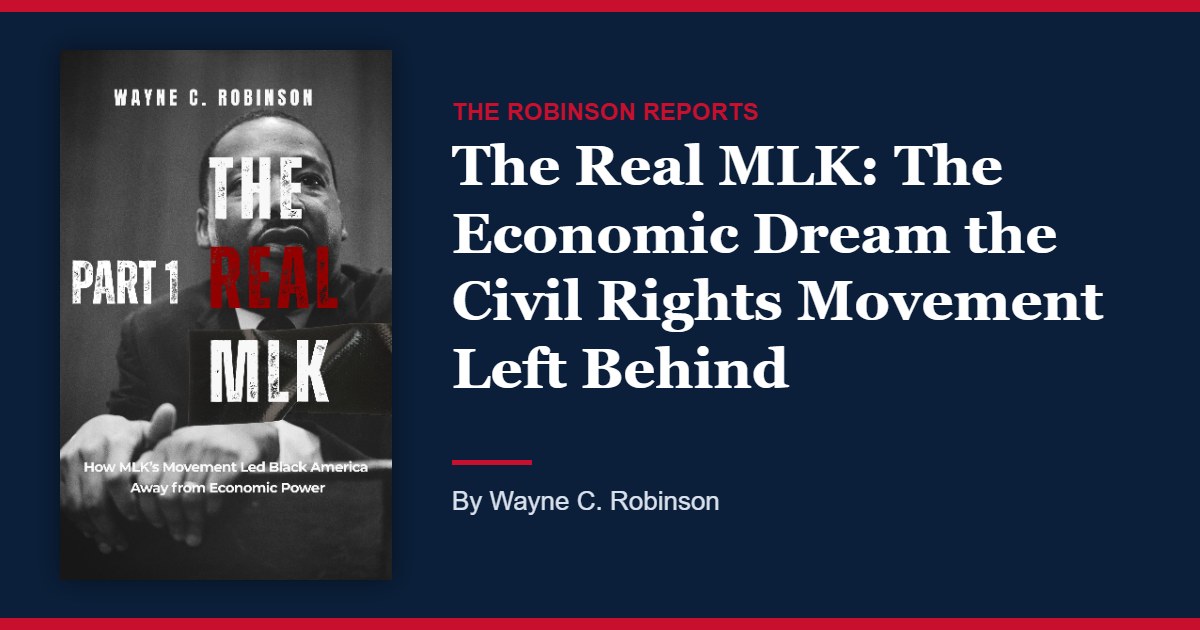
- The Real MLK Part 1: How MLK’s Movement Led Black America Away from Economic Power covers the shift from self-reliance to government dependency.
- The Real MLK Part II: How Martin Luther King Jr. and Communist Ideals Undermined the Black Family examines the FBI files, the advisors, and the impact on Black families.
Instant PDF downloads. Start reading in minutes.