
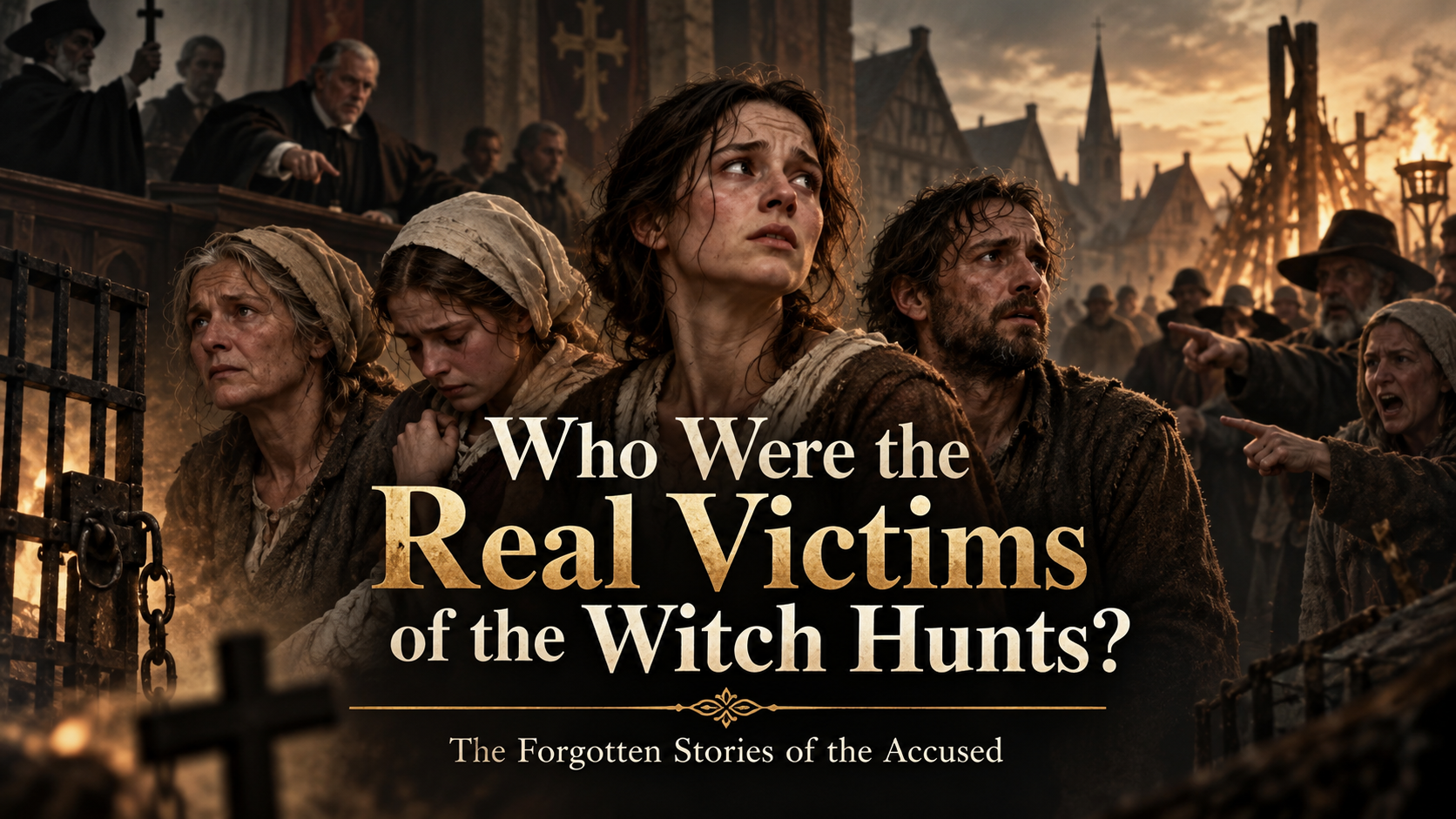
Behind every witchcraft accusation was a human being. Discover how religious fear, prejudice, personal disputes, and the abuse of authority led to the persecution and execution of thousands of people who were never proven to possess supernatural powers.
By Wayne C. Robinson | The Robinson Reports
The People History Remembered as Witches Were Once Ordinary Human Beings
When we hear the word witch, most of us picture a fictional character dressed in black, casting spells, flying on a broomstick, or communicating with supernatural forces. Centuries of religious teachings, folklore, literature, and popular entertainment have created an image so familiar that we rarely question where it originated. Yet behind that image lies a disturbing historical reality. Thousands of people who were accused of witchcraft were not mysterious supernatural beings but ordinary human beings whose lives were destroyed by fear, suspicion, and institutions that accepted extraordinary allegations without reliable evidence.
During the European witch hunts, particularly between the fifteenth and eighteenth centuries, approximately 40,000 to 60,000 people were executed for alleged witchcraft. Many more were investigated, imprisoned, interrogated, or subjected to public humiliation. Their circumstances varied considerably across different countries and historical periods, but they shared one devastating experience: someone accused them of possessing or using supernatural powers, and the accusation became a threat to their freedom, reputation, and sometimes their lives.
The majority of those prosecuted in much of Europe were women, although thousands of men were also accused. Some victims were elderly, impoverished, widowed, or socially isolated, while others were respected members of their communities. They included farmers, servants, mothers, religious believers, and individuals caught in disputes with neighbors or local authorities. They were not members of a single organized religion, nor did they necessarily identify themselves as witches. In many instances, the label was imposed upon them by people who feared or suspected them.
What makes their stories especially tragic is that the supernatural crimes attributed to them were never credibly established. Authorities accused people of causing illnesses, destroying crops, controlling the weather, communicating with demons, and entering into agreements with Satan. These extraordinary claims were frequently supported by rumors, questionable testimony, or confessions obtained under coercion. Meanwhile, the imprisonment, torture, and executions inflicted upon the accused remain documented historical events.
As I researched these persecutions for my book, Who Was Really Evil? Witches, Satan, Christianity, and the Evidence of Who Actually Caused Harm, I became increasingly convinced that understanding the witch hunts requires a change in perspective. Instead of concentrating exclusively on what the accused supposedly did, we should examine who these people actually were, how they became targets, and what their persecutors did to them.
Why Women Became the Primary Targets
One of the most striking characteristics of the European witch hunts was the disproportionate number of women among those accused and executed. Historians generally estimate that women represented approximately three-quarters or more of the victims in many European regions, although the proportions varied substantially by location. In certain areas, men made up a significant share of those prosecuted, demonstrating that witch hunting was influenced by local traditions as well as broader beliefs about gender.
Women’s vulnerability was connected to prevailing social expectations, religious teachings, and assumptions about their supposedly weaker moral or spiritual character. Some influential demonologists portrayed women as particularly susceptible to temptation by Satan, while certain legal and religious authorities interpreted women’s independence, behavior, or social circumstances as suspicious. Widows and unmarried women could be especially vulnerable when they lacked influential relatives or the economic resources necessary to defend themselves.
The connection between gender and witchcraft was reinforced by religious literature, including the notorious Malleus Maleficarum, commonly known as The Hammer of Witches, published in 1486–1487. Associated principally with Heinrich Kramer, the work promoted aggressive prosecution of alleged witches and presented deeply misogynistic arguments about women’s susceptibility to supernatural wrongdoing. Although its ideas were not universally accepted by Christian authorities, the book contributed to an intellectual environment in which accusations against women could appear religiously justified.
It would nevertheless be inaccurate to assume that every woman accused of witchcraft was a healer or that all witch hunts were directed exclusively against women who challenged traditional gender roles. Historical evidence reveals considerable diversity among the accused, including women who were deeply religious, socially respectable, married, and fully integrated into their communities. The important point is that gender expectations and unequal access to power often made it more difficult for women to defend themselves once accusations began.
These women were not executed because historians have established that they possessed supernatural powers. They were executed because courts and communities accepted accusations based on beliefs that could not be independently verified. Their experiences demonstrate how dangerous prejudice becomes when it is reinforced by institutional authority and converted into legal punishment.
Sarah Good: When Poverty Became a Source of Suspicion
The story of Sarah Good, one of the earliest individuals accused during the Salem witch trials of 1692, illustrates how social vulnerability could contribute to persecution. Good lived in poverty and depended partly upon assistance from others in her community. Her difficult circumstances, strained relationships with neighbors, and reputation for responding angrily when refused help made her a convenient target when fears about witchcraft began spreading through Salem Village.
When young girls claimed to be suffering from supernatural attacks, Good was accused of causing their afflictions. During her examination, she denied practicing witchcraft, but the authorities treated the allegations seriously. Testimony about unusual behavior, supposed spiritual attacks, and earlier disagreements helped create a narrative in which an impoverished woman became responsible for frightening events that others could not explain.
Good’s position made an effective defense especially difficult. She lacked the social standing and resources that might have helped her resist accusations, and the religious assumptions surrounding the proceedings allowed witnesses to interpret ordinary conflicts as evidence of supernatural wrongdoing. Her denials could not resolve allegations involving invisible powers, because the court accepted forms of testimony that did not require independent verification.
On July 19, 1692, Sarah Good was hanged along with four other women. Her execution remains one of the clearest examples of the danger faced by socially vulnerable people during the witchcraft panic. The historical records establish that she was accused, examined, condemned, and killed. They do not establish that she possessed the supernatural powers attributed to her.
The circumstances of Sarah Good’s death should lead us to question the assumptions that made her prosecution possible. An impoverished woman who had difficulty maintaining harmonious relationships with her neighbors became the subject of terrifying accusations. Instead of requiring credible proof of the alleged supernatural crimes, the legal system allowed suspicion to become the foundation of a death sentence.
Tituba: An Enslaved Woman Caught in the Salem Panic
Tituba’s experience reveals another important dimension of the witch hunts: the vulnerability of individuals who possessed little control over their lives. Tituba was an enslaved woman in the household of Reverend Samuel Parris, whose daughter and niece were among the first people reported to be suffering from unusual afflictions in Salem. Her exact birthplace and ethnic background remain subjects of historical discussion, but her status as an enslaved person placed her in a profoundly unequal position when accusations emerged.
Along with Sarah Good and Sarah Osborne, Tituba became one of the first three people formally accused during the crisis. During questioning, she confessed to involvement in witchcraft and described supernatural activities that appeared to confirm the community’s fears. Her testimony included allegations involving the Devil and other supposed participants in a larger conspiracy. Rather than ending the investigation, her confession contributed to the growing belief that Salem faced an organized supernatural threat.
Historians have examined the pressures surrounding Tituba’s confession, including the unequal power relationships that shaped her circumstances. It is important not to present every detail of her motivations as established fact, because the surviving record does not allow us to know precisely why she made particular statements. Nevertheless, her position as an enslaved woman being interrogated by colonial authorities must be considered when evaluating the reliability of her testimony.
Unlike Sarah Good, Tituba was not executed. She remained imprisoned for an extended period before eventually being released from custody, and much of her later life remains uncertain. Her story demonstrates that the consequences of witchcraft accusations extended beyond execution. Imprisonment, coercion, public suspicion, and the loss of personal freedom could devastate lives even when a defendant survived.
Tituba also demonstrates how misleading popular retellings can become. Fictional accounts have frequently transformed her into a mysterious practitioner of exotic magic, despite the limits of the historical evidence. Such portrayals risk repeating the same error committed by her accusers: allowing speculation and dramatic storytelling to obscure the experiences of a real human being.
Rebecca Nurse: Even Respectability Offered No Protection

Rebecca Nurse was an elderly woman whose reputation for religious devotion and respectable conduct should, in theory, have protected her from suspicion. A longtime resident of the Salem area, she had family members and neighbors who supported her and believed in her innocence. Yet in March 1692, she became the subject of witchcraft accusations, demonstrating that the panic had expanded beyond individuals already considered socially vulnerable or troublesome.
During her trial, the jury initially found Nurse not guilty. Following objections and further consideration, however, the verdict was reconsidered, and she was ultimately convicted. Her case is particularly troubling because it illustrates how a legal process could be influenced by the expectations and fears surrounding the accusations. The willingness to reconsider an acquittal raises serious questions about the fairness of the proceedings and the difficulty of defending oneself against supernatural allegations.
Rebecca Nurse was hanged on July 19, 1692. Her execution devastated her family and became one of the best-known examples of the injustice of the Salem witch trials. She had been accused of cooperating with Satan, yet the surviving records provide no credible evidence that she possessed supernatural powers or had entered into any agreement with a supernatural being.
The case of Rebecca Nurse challenges the idea that witchcraft accusations were always directed at outsiders who lived beyond the accepted boundaries of society. Even respected members of a religious community could become targets when collective fear overwhelmed rational judgment. Once authorities accepted that Satan might operate through apparently ordinary Christians, no person’s reputation could guarantee safety.
Her story also illustrates the difference between religious devotion and protection from religious persecution. Nurse was herself a Christian, yet people who claimed to be defending Christian society condemned her as an agent of the Devil. That contradiction deserves serious examination because it reveals how accusations of spiritual evil could override the very moral principles that religious communities professed to uphold.
Men Were Also Victims of the Witch Hunts
Although women made up the majority of those executed for witchcraft in much of Europe, men also suffered persecution. In some regions, including Iceland and parts of northern and eastern Europe, men represented a particularly large share of those prosecuted. This regional variation demonstrates that witchcraft accusations were not governed by one universal pattern. Local beliefs, legal traditions, political circumstances, and community relationships all influenced who became a suspect.
Men accused of witchcraft included farmers, laborers, religious figures, and individuals involved in conflicts with their neighbors or authorities. Some were suspected of practicing harmful magic, while others became implicated through accusations involving supernatural conspiracies. Like their female counterparts, they could face interrogations, imprisonment, torture, and execution despite the absence of credible evidence establishing that they possessed supernatural powers.
One prominent example was Reverend George Burroughs, a former minister in Salem Village who became a defendant during the trials of 1692. Accusers claimed that he possessed extraordinary strength and participated in supernatural wrongdoing. He was convicted and hanged on August 19, 1692, despite the fact that his alleged powers could not be independently demonstrated.
Burroughs reportedly recited the Lord’s Prayer before his execution, an event that disturbed some observers because of the belief that a genuine witch would be unable to perform such an act. Nevertheless, the execution proceeded. The incident illustrates how even behavior that challenged popular assumptions about witchcraft could fail to protect an accused person once authorities had reached a conclusion about guilt.
The persecution of men is important because it prevents us from reducing the witch hunts to a single explanation. Misogyny was an important factor in many prosecutions, but religious fear, political authority, legal practices, and social conflict also contributed to the persecution of people from different backgrounds. Understanding these complexities makes the historical case against unjust prosecutions stronger, not weaker.
Anna Göldi: A Witchcraft Persecution in the Age of Enlightenment
One of the most revealing later cases occurred in Switzerland in the eighteenth century, long after the most intense period of European witch hunting. Anna Göldi, a domestic servant in the canton of Glarus, became involved in accusations arising from her employment in the household of a prominent physician. She was accused of causing harm to a child through extraordinary means, including allegations involving pins and other objects supposedly appearing in the child’s body.
Göldi’s case developed within a complicated social environment involving unequal power, accusations of wrongdoing, and the influence of prominent members of the community. Although her prosecution included accusations resembling witchcraft, the formal legal proceedings did not simply follow the patterns of earlier European witch trials. She was convicted under accusations involving poisoning, but her case has become widely associated with the history of witch persecution.
In 1782, Anna Göldi was executed by beheading. Her death occurred during a period when Enlightenment ideas about rational inquiry, legal reform, and skepticism toward supernatural accusations were already influencing European intellectual life. The fact that such a prosecution could still occur demonstrates how deeply entrenched systems of authority and social inequality could continue producing injustice even as attitudes toward witchcraft were changing.
Göldi was formally rehabilitated by the Glarus authorities in 2008, more than two centuries after her execution. Today, a museum in her memory examines her prosecution and its relevance to questions of justice, power, human rights, and historical responsibility. Her story serves as an important reminder that persecution is not limited to societies commonly dismissed as ignorant or primitive. Even communities familiar with developing ideas of reason and legal reform can participate in profound injustice.
The case of Anna Göldi also illustrates why historical investigation should examine the actual circumstances of an accusation rather than accept the labels attached to it. Her experience involved complex issues of class, authority, legal procedure, and alleged wrongdoing. Reducing her story to a simple tale about a witch overlooks the human conflicts and institutional decisions that made her execution possible.
How Ordinary Misfortune Became Evidence of Witchcraft
A central feature of the witch hunts was the tendency to interpret ordinary misfortune as evidence of supernatural wrongdoing. In communities where medical knowledge was limited and belief in spiritual forces was widespread, illness, unexpected deaths, crop failures, and unusual behavior could become sources of intense fear. When people could not explain a tragedy, they sometimes searched for someone to blame, particularly if that person already had a poor reputation or had recently been involved in a dispute.
Imagine a farmer whose livestock suddenly becomes ill after an argument with a neighbor. Without understanding the biological cause of the illness, the farmer might conclude that the neighbor had placed a curse upon his animals. Other residents could recall similar misfortunes, gradually creating a collection of suspicious events that appeared to support the accusation. In reality, the connection might exist only in the minds of people attempting to explain events they did not understand.
Illness and unusual physical symptoms could be especially frightening. Epileptic seizures, convulsions, psychological distress, and other conditions were sometimes interpreted through religious or supernatural explanations. People experiencing such symptoms might be considered victims of witchcraft, while others could be accused of causing the afflictions through demonic powers. The lack of reliable medical explanations made these beliefs particularly difficult to challenge.
We should be careful not to claim that every unexplained illness resulted in a witchcraft accusation or that every historical observer rejected natural explanations. Physicians, theologians, and legal authorities held differing views, and some recognized that apparently supernatural events might have ordinary causes. Nevertheless, the widespread willingness to consider witchcraft as an explanation for misfortune created an environment in which innocent people could become suspects.
The fundamental mistake was the assumption that unexplained suffering required a supernatural culprit. A person’s illness may be real, but that does not establish that another individual caused it through magic. Without credible evidence connecting an accused person to an actual crime, allegations of witchcraft remained suspicions rather than demonstrated facts.
The Cruelty of Torture and Forced Confessions
The persecution of accused witches was made even more devastating by the use of torture in various European jurisdictions. Investigators sometimes believed that individuals involved in witchcraft would refuse to confess because of their supposed loyalty to Satan. Under this assumption, denial could become further evidence of guilt, and torture could be justified as a method of overcoming supernatural deception.
The resulting confessions frequently included extraordinary descriptions of demonic gatherings, agreements with the Devil, magical flights, and participation in secret rituals. Some accused individuals implicated neighbors or family members, causing investigations to expand. Authorities then interpreted these statements as confirmation that an organized witchcraft conspiracy existed, even though the confessions had been obtained under circumstances that made them profoundly unreliable.
Modern understanding of coercive interrogation helps explain why torture can produce false confessions. People subjected to extreme pain may agree with accusations or invent accounts they believe their interrogators want to hear. The objective becomes ending the suffering rather than providing an accurate description of events. When investigators already possess a detailed theory of supernatural wrongdoing, they may unintentionally or deliberately shape the statements obtained from suspects.
The historical consequences were catastrophic. Confessions produced through coercion could become the basis for convictions, executions, and further investigations. In some regions, one prosecution led to numerous additional accusations, creating cycles of persecution that devastated entire communities. The supposed evidence of supernatural conspiracies was generated through the very procedures used to investigate them.
This is one of the most disturbing contradictions in the history of the witch hunts. Authorities claimed to be protecting society from people who supposedly caused suffering through invisible supernatural powers. Yet those same authorities sometimes employed physical torture to produce confessions supporting their beliefs. The alleged supernatural harm remained unproven, while the violence inflicted upon the accused was real and documented.
Were the Accused Witches Actually Practicing Witchcraft?
It is important to distinguish between historical people accused of witchcraft and contemporary individuals who identify as witches. Modern Wicca and related spiritual traditions developed in substantially different historical circumstances, and their beliefs cannot automatically be attributed to people prosecuted centuries earlier. Many defendants during the European witch hunts identified as Christians and denied any involvement in witchcraft.
Some historical individuals may have practiced folk healing, divination, charms, or other forms of traditional magic. Others may have accepted beliefs in supernatural forces without participating in the activities attributed to them. Still others appear to have been accused because of personal disagreements, social vulnerability, or circumstances entirely unrelated to magical practices. The historical category of witch therefore included people with very different beliefs and experiences.
The question of whether any accused individual practiced folk magic is also separate from the claim that the person possessed supernatural powers. A person might perform a ritual, recite a charm, or believe that a spell could influence events without demonstrating that the ritual produced supernatural effects. Likewise, someone could be accused of harmful magic without practicing any ritual at all.
These distinctions are essential because the historical injustices cannot be understood by treating all accused individuals as members of a single religious movement. The victims were diverse human beings who became targets within particular social and legal environments. What connected them was not a proven relationship with Satan but the willingness of others to accuse them of one.
The Responsibility of Religious and Governmental Authorities
Religious beliefs played an important role in shaping witchcraft accusations, but responsibility for the persecutions extended beyond religious institutions alone. Catholic and Protestant societies both experienced witch hunts, and secular courts frequently carried out investigations, convictions, and executions. Local officials, political rulers, neighbors, and community leaders also participated in creating or sustaining the conditions under which accusations became dangerous.
The relationship between religious doctrine and legal authority was particularly significant. When theologians described witchcraft as an offense against God and society, legal officials could interpret suspected magical practices as threats requiring severe punishment. In regions where courts accepted torture or unreliable forms of testimony, supernatural accusations became especially difficult to challenge. The interaction between belief and state power transformed suspicion into a mechanism of persecution.
Historical responsibility must nevertheless be assigned carefully. Not every Christian supported witch trials, and some religious thinkers actively challenged the reliability of accusations and the use of torture. Courts and governments also differed greatly in their willingness to prosecute alleged witches. Some jurisdictions experienced intense persecution, while others maintained restrictions that reduced the number of convictions.
Acknowledging these distinctions does not diminish the suffering of the victims. Instead, it helps identify the institutions, decisions, and legal procedures that allowed persecution to occur. A meaningful historical investigation should ask which authorities authorized punishment, what evidence they accepted, whether defendants received a fair opportunity to defend themselves, and how religious assumptions influenced the outcome.
The moral question remains unavoidable. If authorities condemned individuals for supernatural crimes that were never credibly established, while subjecting them to documented imprisonment, torture, and execution, how should history evaluate their actions? Sincere religious conviction may help explain why persecution occurred, but it cannot erase responsibility for the suffering inflicted upon innocent people.
Why Their Stories Changed My Understanding of Witchcraft
My interest in the victims of witch persecution grew out of my own experiences and changing understanding of religion. I was raised with Christian teachings that associated witches with Satan, demons, and evil. For much of my life, I accepted these beliefs because they were presented as established religious truths. I did not initially question how those beliefs developed or whether they accurately represented the people historically accused of witchcraft.
Years later, while conducting fall foliage tours in Salem, Massachusetts, I became more interested in the history of the witch trials. During my time there, I met the sister of Laurie Cabot, a prominent figure associated with modern American witchcraft. That encounter encouraged me to reconsider some of the assumptions I had inherited and to investigate the subject more thoroughly.
As I learned about people who identify as witches today, I encountered beliefs emphasizing nature, healing, spiritual independence, and personal responsibility. These experiences challenged the image of witches as inherently evil individuals. They also inspired me to distinguish contemporary spiritual traditions from the historical accusations that led to persecution.
My research gradually expanded into the history of Satan, Christian demonology, European witch trials, and the legal systems that prosecuted suspected witches. I began examining the allegations made against historical defendants and comparing them with the documented actions of their accusers. The contrast became increasingly difficult to ignore. While the supernatural crimes remained unproven, the imprisonment, torture, and executions carried out by human authorities were supported by historical records.
This investigation ultimately became the foundation of my book, Who Was Really Evil? Witches, Satan, Christianity, and the Evidence of Who Actually Caused Harm. The purpose of the book is not to claim that every accused person was morally perfect or that every religious believer participated in persecution. It is to ask whether history has too often accepted frightening accusations against the supposed witches while failing to examine the documented harm inflicted upon them.
Remembering the Victims as Human Beings
The victims of the witch hunts deserve to be remembered as more than names on lists of executions. Sarah Good was a woman struggling with poverty before she became an accused witch. Rebecca Nurse was an elderly Christian whose community eventually condemned her. Tituba was an enslaved woman whose words and circumstances became central to a terrifying religious panic. George Burroughs was a former minister accused of extraordinary powers, while Anna Göldi was a servant whose prosecution reflected the influence of authority and unequal social power.
Their lives were not identical, and the circumstances surrounding their accusations differed considerably. Nevertheless, their stories reveal a recurring pattern in which people became vulnerable to accusations they could not meaningfully disprove. Personal disputes, religious fears, social inequality, and institutional authority often combined to make the allegations more influential than reliable evidence.
When we reduce these individuals to the word witch, we risk repeating the assumptions that contributed to their persecution. The label can obscure their humanity and encourage us to imagine supernatural characteristics rather than examine their actual circumstances. Historical investigation should restore that humanity by considering the lives they lived, the accusations they faced, and the decisions that led to their suffering.
The names preserved in historical records represent only part of the tragedy. Many individuals who experienced investigations, imprisonment, humiliation, or the loss of family members left behind limited documentation. Their experiences remind us that the damage caused by persecution cannot be measured solely through execution totals. Fear and suspicion can destroy communities even when accusations do not result in death.
Who Were the Real Victims, and Who Was Responsible for Their Suffering?
The historical record provides a compelling answer to the first question. The real victims of the witch hunts were the human beings who experienced imprisonment, torture, execution, social isolation, and the destruction of their families because others believed they possessed supernatural powers. They came from different backgrounds and held different beliefs, but they were united by the fact that the extraordinary allegations against them were not supported by credible evidence demonstrating actual supernatural wrongdoing.
The second question requires us to examine the conduct of individuals and institutions. Accusers made allegations, witnesses provided testimony, courts evaluated evidence, and authorities authorized punishments. Some participants sincerely believed they were protecting society from evil, while others may have been influenced by personal grievances, social pressures, or political interests. Their motivations varied, but the consequences of their decisions can be documented.
For centuries, popular narratives have emphasized the supposed dangers posed by witches. Religious teachings and fictional stories have portrayed witches as agents of Satan capable of causing unimaginable harm. Yet when we examine the historical evidence, we encounter a very different reality. The supernatural crimes attributed to the accused remain unproven, while the violence inflicted upon them by human beings is extensively documented.
That distinction changes the way we should remember the witch hunts. The central tragedy was not the discovery of a hidden supernatural conspiracy. It was the willingness of communities and institutions to condemn people for crimes they could not credibly establish. The real danger was the combination of fear, prejudice, and authority exercised without sufficient regard for evidence or justice.
The lesson extends beyond witchcraft and religious history. Whenever people are condemned because of what others believe they represent, rather than what reliable evidence demonstrates they have done, the possibility of injustice grows. The victims of the witch hunts remind us why human dignity, freedom of conscience, and fairness must never depend upon conformity to the religious or social expectations of those holding power.
For centuries, the accused were remembered as witches. Perhaps history should remember them first as human beings who suffered because others claimed to be fighting evil.
Their lives deserve to be remembered, their stories deserve to be examined, and those responsible for their persecution deserve to be judged by the same standard of evidence that their victims were so often denied.
Discover the Book: Who Was Really Evil?
Witches, Satan, Christianity, and the Evidence of Who Actually Caused Harm
By Wayne C. Robinson
For centuries, witches were put on trial. This book puts their accusers on trial.
My investigation into the history of witchcraft began during my experiences conducting tours in Salem, Massachusetts. What I discovered eventually led me into centuries of religious history, the development of Satan in Christian theology, and the persecution of people accused of supernatural wrongdoing.
In Who Was Really Evil?, I examine the accusations that led to the imprisonment, torture, and execution of thousands of people. I explore how religious beliefs influenced those persecutions and challenge readers to reconsider the traditional portrayal of witches as the villains of history.
This book asks a fundamental question: If the alleged supernatural crimes of witches were never credibly established, while the violence committed against them is extensively documented, who should history hold responsible for the real harm?
Read the evidence. Question the accusations. Decide for yourself.

Wayne C. Robinson
Author | Researcher | U.S. Navy Veteran Journalist
© 2026 Wayne C. Robinson. All rights reserved.